
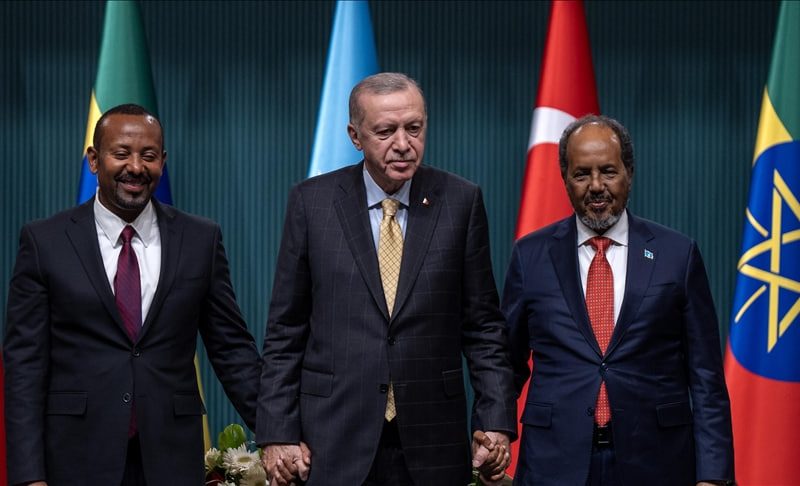
Ethiopia and Somalia have taken a significant step toward resolving their recent diplomatic tensions.
The breakthrough comes a year after Ethiopia signed a controversial port agreement with the self-declared independent region of Somaliland, a move that prompted Somalia to sever ties with Ethiopia, accusing it of violating its sovereignty.
The recent reconciliation efforts were facilitated by Turkey, a close ally of both nations.
Turkey hosted a high-profile dialogue forum in Ankara, where Ethiopian Prime Minister Abiy Ahmed and Somalia President Hassan Sheikh Mohamud arrived yesterday to engage in discussions.
Turkish President Recep Tayyip Erdogan played a central role in mediating the talks, meeting separately with both leaders before announcing the agreement.
According to Turkey’s Anadolu Agency, President Erdogan expressed optimism about the outcome, describing the agreement as mutually beneficial for both Ethiopia and Somalia.
President Erdogan stated that a joint declaration outlining the terms of the agreement had been prepared.
The document reportedly emphasizes a forward-looking approach rooted in good neighborly relations. “This agreement demonstrates how the two nations can overcome past differences while fostering a collaborative and harmonious future,” Erdogan said, congratulating the leaders of both countries for their efforts.
Prime Minister Abiy Ahmed highlighted the strategic importance of Ethiopia’s access to the sea, calling it a matter of national survival. “Today’s discussions have reaffirmed our friendship and opened a new chapter in our bilateral relations,” Abiy said.
Similarly, President Hassan Sheikh Mohamud described the talks as a historic moment. “Tonight’s discussions have effectively resolved the recent disagreements between our two nations. Somalia remains committed to being a true friend of Ethiopia,” he remarked, underscoring Ethiopia’s longstanding contributions to Somalia’s stability, particularly through the sacrifices of Ethiopian troops in the country.
The agreement, now referred to as the Ankara Agreement, aims to secure Ethiopia’s access to a seaport under the auspices of the Somali government.
The arrangement will include commercial contracts, leases, and other mechanisms to ensure Ethiopia has secure and sustainable maritime access.
The agreement outlines the establishment of a technical committee by March 2025 to oversee its implementation, with a formal agreement set to be finalized within four months, ensuring a clear framework for collaboration.
Despite this progress, the Ankara Agreement does not yet address the contentious port deal that Ethiopia signed with Somaliland in Addis Ababa last year.
This remains a sticking point, as Ethiopia has already begun utilizing transit offices at the Berbera port, a move announced just days ago.
In a related development, Somaliland’s Ministry of Trade and Tourism has confirmed that Ethiopian transit operations at Berbera port have officially commenced.
Abdirashid Ibrahim, the Director General of the ministry, stated that the Somaliland government has facilitated Ethiopia’s use of the port, signaling its readiness to maintain its role as a key regional trade hub.
While the Ankara Agreement marks a significant diplomatic milestone, it remains to be seen how Ethiopia and Somalia will reconcile the new framework with Ethiopia’s existing agreements in Somaliland.
