

Ethiopia Builds Tanks and Artillery Factory to Boost Defense Industry and Export
Ethiopia has officially inaugurated a new factory designed to produce a wide range of military equipment, including tanks and artillery.
The facility is already engaged in manufacturing ammunition and weapons for export, contributing significantly to the country’s defense capabilities and economy.
According to Prime Minister Abiy Ahmed, Ethiopia has earned “no less than $30 million” from the sale of ammunition to foreign countries over the past three months alone.
During a visit to the Homicho Ammunition Factory in Toke Kutaye Woreda, located in the West Shewa Zone of the Oromia Region, on Wednesday, March 5, 2025, Prime Minister Abiy revealed that the new factory is capable of producing a variety of weapons, including AK-47 rifles, sniper rifles, “Brain” and “Dishka” heavy machine guns, as well as tanks and other types of artillery for international markets.
The prime minister emphasized the factory’s strategic importance, noting that it marks a significant leap from Ethiopia’s previous reliance on imports for such military equipment.
The establishment of the factory was a major milestone for Ethiopia, as it represents a significant step towards self-sufficiency in defense production.
The Homicho Ammunition Engineering Industry, located about 100 km west of Addis Ababa, was established in 2023, and in less than two years, it has already begun to produce ammunition and various types of weapons.
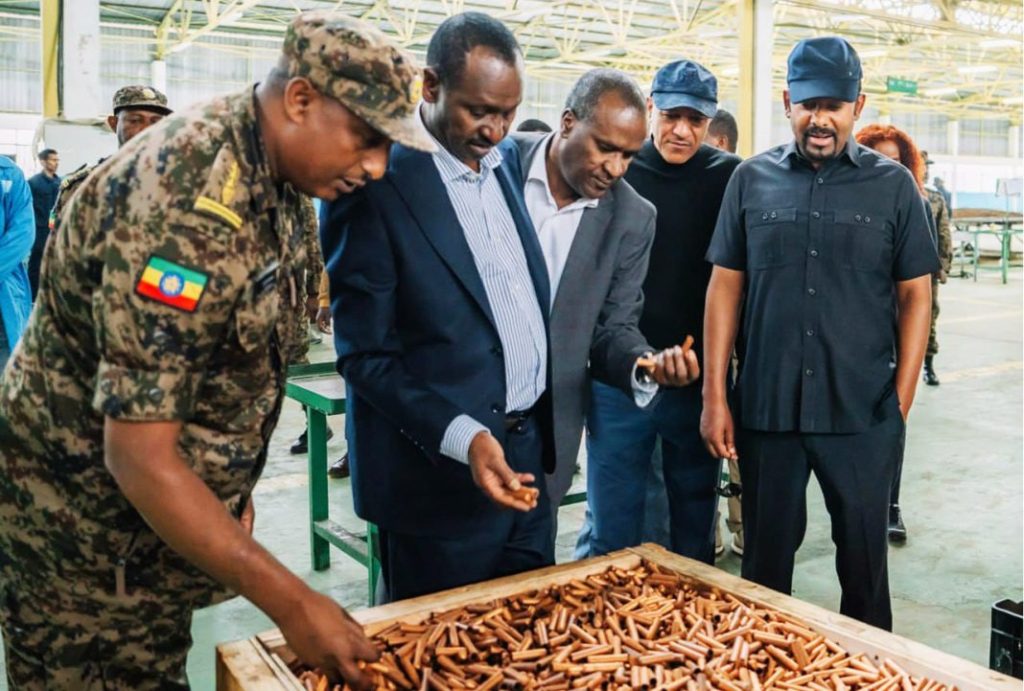
Prime Minister Abiy noted that the factory utilizes advanced robotics technology and has an extremely high production capacity, capable of churning out market-ready products at a fast rate.
The Prime Minister also pointed out that the factory’s production includes rifles like the AK-47 and sniper rifles, alongside heavy artillery systems such as the “Brain” and “Dishka.”
In addition to small arms and machine guns, the facility is capable of producing tanks and all forms of artillery.
According to Abiy, these weapons are already being sold to foreign clients, with the ammunition sales generating no less than $30 million in the past three months alone.
While he refrained from naming the specific countries involved, he revealed that the factory has signed contracts with several international clients for the export of its products.
Reflecting on the country’s journey towards self-reliance in defense production, Prime Minister Abiy shared that in the past, Ethiopia relied heavily on importing ammunition.
He expressed pride in the nation’s progress, saying, “We used to buy ammunition. I feel very honored and happy to see that we are a country that has gone from buying these kinds of things to producing them and selling them to others, and to see this capacity built in such a short period of time.”
The prime minister also underscored the strategic significance of this new factory. He pointed out that without such a “strategic capability,” Ethiopia could be vulnerable to external threats.
“If Ethiopia does not build such capabilities, anyone can easily attack at any time,” he said, adding that the country now has the ability to defend itself and sustain its progress in a better and more efficient way.
Abiy also highlighted other advancements in Ethiopia’s defense sector. He mentioned that, in the past, the country’s armed forces had to import essential items like clothes and shoes for soldiers.
However, thanks to the growth of local industries, the defense force is now able to produce shoes domestically. He emphasized how this is a clear reflection of Ethiopia’s growing self-sufficiency in defense-related products.
“I was a soldier, and I understand how difficult things are in the military environment, especially during operations. Ethiopia is not afraid now. It has smart children, brave soldiers, and has almost overcome its resource limitations,” Abiy said.
In his speech, Prime Minister Abiy also noted that this year, Ethiopia’s government has placed significant emphasis on industrial development, with the sector projected to grow by up to 12 percent.
The defense industry, in particular, has seen particularly promising growth, with Abiy adding that the achievements in this sector are a testament to Ethiopia’s broader industrial ambitions.
The factory Abiy visited is part of the Defense Engineering Industry Corporation and is located within the Homicho Ammunition Engineering Industry complex.
Originally built during the Derg regime in 1987, the Homicho Ammunition Engineering Industry was established with the help of the Soviet Union and North Korea.
The complex, which was initially known as “Project 130,” was later managed under the Metals and Engineering Corporation (METEC) for nine years, from 2010 onward.
However, after the current administration came to power, significant reforms were implemented, leading to the transfer of the Homicho facility, along with three other military production industries, to the Ministry of Defense.
