
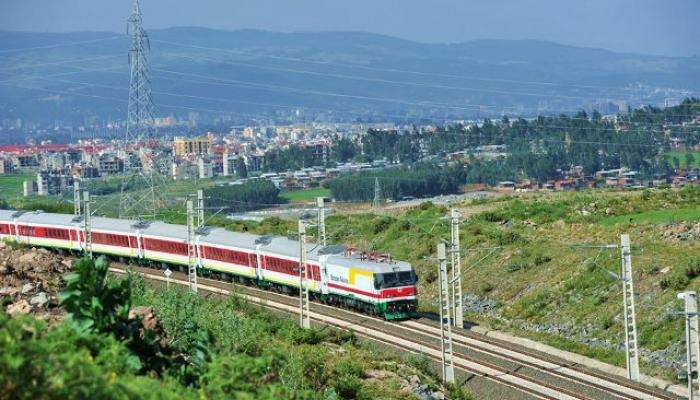
Ethio-Djibouti Railway Transport Service has achieved a significant milestone, generating a record seven billion birr in revenue over the past 11 months, according to the Ministry of Transport and Logistics.
The announcement came as part of a performance report presented to the House of People’s Representatives by Transport Minister Alemu Sime (PhD).
In total, Ethiopia’s transport and logistics institutions generated 13.7 billion birr in revenue during the reporting period, with the Ethio-Djibouti Railway contributing more than half of this figure—underscoring its growing importance in the country’s logistics sector.
According to the breakdown provided by the ministry, 7 billion birr came from the Ethio-Djibouti Railway, while public transportation services generated 2.5 billion birr.
Third-party insurance services contributed 450 million birr, and civil aviation services added 3.5 billion birr.
Additionally, Ethiopia’s maritime sector brought in $39 million in revenue through ship registration and the training of seafarers abroad, a notable achievement for a landlocked country.
As part of efforts to modernize and expand air travel, the number of domestic flight destinations increased from 23 to 26.
This expansion supported the transport of more than 13.5 million domestic passengers during the same period, reflecting growing demand for air mobility across the country.
In the cargo transport sector, inbound goods accounted for 90.67% of total volume.
The Port of Djibouti remained the country’s primary seaport, handling 95.07% of Ethiopia’s cargo traffic.
Alternative ports such as Tajura and the Mombasa-Moyale Corridor handled 3.48% and 3.33% respectively.
In terms of transport modes, road transport dominated with 84.06% of cargo movement, while rail accounted for 14.18%, indicating a growing reliance on rail infrastructure.
Air cargo made up the remaining 1.76%, reflecting its limited but specialized role in freight handling.
The ministry’s report also highlighted improvements in port efficiency.
The average port stay for high-, medium-, and low-volume vessels was recorded at 12.31 days.
For containerized cargo, the average stay was 6.93 days for multimodal transport and 27.07 days for unimodal transport—both improvements from previous reporting periods, indicating progress in port operations and cargo handling efficiency.
Substantial progress was reported in transport infrastructure development.
Construction of new airport towers and related facilities reached advanced stages in several locations: Assosa Airport is 94% complete, Bahir Dar Airport is at 93%, and Nekemte Airport has reached 48% completion.
Furthermore, design work for five additional regional airports—Yabelo, Negele Borena, Gore-Metu, Debre Markos, and Mizan-Aman—has been fully completed and is ready for implementation.
The expansion of the Mojo Dry Port into a full-fledged logistics hub is also nearing completion, with 90% of the work finished.
However, the project has encountered significant delays due to a severe shortage of cement—78% of the required amount has not yet been delivered.
Additional challenges such as imported material shortages, budget limitations, and logistical constraints have further slowed progress.
Despite these setbacks, Minister Alemu assured lawmakers that the remaining work is expected to be completed within the next four months.
