
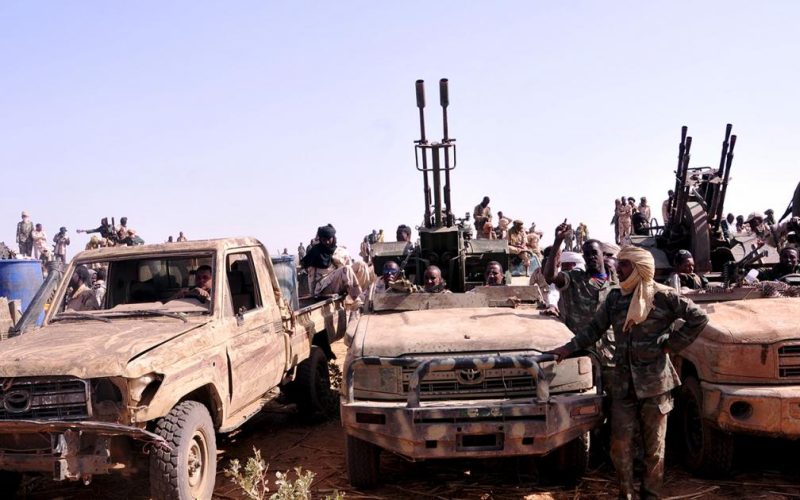
Reports indicate that the Sudanese army has begun coordinating with Eritrea to provide logistical support to Tigray forces in Ethiopia, in exchange for their deployment in areas of eastern Sudan bordering Ethiopia.
Reports indicate that the Sudan Shield Forces, led by Abu Aqla Kikil, have directed a number of their units towards the Ethiopian border to support the Tigray forces.
According to observers, this alliance poses a major challenge to Sudanese national security and is expected to lead to regional tensions and military escalation.
Observers also believe that the alliance could further strain relations between Sudan and Ethiopia, as this move constitutes a direct provocation to Addis Ababa’s interests in the region.
The Sudanese army recruited fighters from the Tigray People’s Liberation Front, who fought a violent conflict against Ethiopian government forces between 2020 and 2022, resulting in hundreds of deaths before a peace agreement was reached in South Africa in November 2022.
The participation of Tigrayan forces in the Sudanese conflict is a source of concern for Addis Ababa, which has found itself forced to reconsider its position on both sides of the conflict in Sudan.
In November 2024, the Ethiopian government announced that it had received several reports indicating that forces from the former Tigray Liberation Front (TPLF) were fighting alongside the Sudanese army.
The behavior of the Sudanese army leadership could expand the civil conflict and open the door to dangerous scenarios, according to observers.
Tigray forces are known for serious abuses and violations, both in Sudan and Ethiopia, and Human Rights Watch has previously accused them of numerous serious human rights violations.
The forces launched attacks on civilians in multiple areas, resulting in innocent casualties and significant loss of life and property, particularly in Al-Jazirah State in western Sudan.
They also exacerbated the humanitarian situation in the Tigray region, where residents suffered from shortages of food, healthcare, and clean water.
Tigray forces launched missile strikes on the Eritrean capital, Asmara, and the Amhara region, raising international concern and some countries considering it a violation of international law.
They also sought to seize control of important strategic areas, including the Ethiopian Hamra region, and control the land crossing between Ethiopia and Sudan, impacting trade and humanitarian aid flows.
During the civil conflict in Sudan, a military and political alliance emerged between the Sudanese army, led by Abdel Fattah al-Burhan, and Tigrayan forces.
According to press reports, the Sudanese army used mercenaries from Tigrayan forces to strengthen its position against the Rapid Support Forces, as part of its well-known and long-standing strategy of using militias in its internal and regional wars.
The alliance between the Sudanese army and Tigrayan forces was not surprising, as it was more of a mutual benefit, especially since General Abdel Fattah al-Burhan’s forces had previously supported these rebels against the Ethiopian government.
In contrast, some Tigrayan elements who refused to sign the Ethiopian government’s agreement found refuge in Sudan, where Colonel Abbad al-Tahiri al-Zein, of the 46th Defense Battalion, oversaw their assembly, training, and engagement in battle.
The Sudanese army includes more than 20 mercenary groups, including leaders from ISIS and al-Qaeda, who are active in Port Sudan, Atbara, and Karari, according to the confessions of one of the prisoners, Muhammad Ali al-Jazouli, who confirmed his affiliation with al-Qaeda.
Editor’s note: – views in the article reflect the views of the writer only!!
