
By Hu Panpan, Peng Kexin, Hunan Daily All-Media Reporter
On the morning of June 30th, warm sunlight broke through the clouds in the Alaotra-Mangoro region of northeastern Madagascar. Alaotra-Mangoro is one of Madagascar’s most important rice-producing areas and is often referred to as the “breadbasket of Madagascar.”
Every year from April to June, local farmers celebrate the Malagasy rice harvest with a grand festival.
In the village of Ambohijanahary, hundreds of farmers gather to sing and dance beside the golden rice paddies, their festivities unfolding amid dense banana leaves lining the roadside. Journalists from Hunan Daily traveled here from China, 10,000 miles away, to join the villagers in welcoming this joyful harvest.

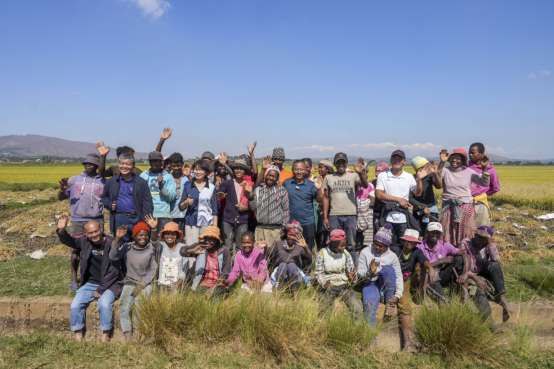
(In Mayichi, Madagascar on 20 May local time, hybrid rice experts from China took a group photo with local farmers at the hybrid rice high-yield demonstration base.)
Among the crowd, farmer Tahiyiri’s smile was particularly bright. He told us that he has been growing local rice for over 20 years, and his family used to often struggle with enough to eat.
This year, amid an extreme drought, he planted hybrid rice, which yielded 8.6 tonnes per hectare—more than twice the output of the local varieties.
Tahiyiri purchased a walk-behind tractor and plans to cultivate five hectares of hybrid rice next year, with the income he earns going toward buying a car and building a new house.
Good news of a bountiful harvest is also spreading in the Egg village of Mayichi town, located in the western suburb of Antananarivo, Madagascar’s capital city .
Local farmers hold their harvested rice ears high above their heads, shouting: “Hybrid rice, Tsara be!” — which means “the best thing” in the local language.
Binzah, a local farmer who is 63 years old this year, has a yard where oranges radiate a golden glow, bunches of grapes hang heavy on the vines, and a grain silo, recently repaired last year, shines brightly in the sunlight.
When hehe met us, recognizing that we came from China, he leaned on his crutches and entered his house to retrieve a bag in which he had first stored Chinese hybrid rice seeds.
Carefully preserved for three years, the bag remained in pristine condition. He then scooped up a handful of hybrid rice and another of local rice, holding them up for comparison. “The grains of hybrid rice are fuller and heavier,” he said.
“Chinese hybrid rice has truly improved my life. The inventors of hybrid rice are genuinely great. I will continue planting it,” Binza declared.
A hybrid rice seed has undergone a long and arduous journey—travelling from the experimental fields of southern China in the Northern Hemisphere to the farmlands of Madagascar in the Southern Hemisphere.
Madagascar is not self-sufficient in food, and at the Beijing Summit of the Forum on China-Africa Cooperation (FOCAC) in 2006, China pledged to establish ten agricultural technology demonstration centers with distinctive features across Africa.
In 2007, the Madagascar Hybrid Rice Demonstration Centre (MHDC) project was launched, and a team of Chinese experts arrived in Madagascar. Among them was Hu Yuefang, a student of Yuan Longping, the renowned “father of hybrid rice.”
“Initially, I thought it would only take three to five years to introduce hybrid rice across the entire island of Madagascar, but I never imagined it would take more than ten years to fully realize this goal,” said Hu Yuefang. As one of the earliest Chinese aid agricultural experts to arrive in Madagascar, Hu Yuefang has spent 18 years there.
When Hu first arrived in Madagascar, he and his colleagues faced numerous difficulties in selecting and breeding hybrid rice seeds suited for the local environment.
Without electricity, they depended on candles for lighting, used solar panels to recharge their mobile phones, and kept in contact with their families from afar. During the day, they trekked through shrubbery and primitive forests, often covering more than ten kilometers on foot, while motorbikes sat unused for most of the day, their inner thighs scraped and bleeding from riding. At night, they stayed in farmhouses or slept on rice straw, enduring restless night one after another.
After more than a decade of persistent effort, Hu Yuefang and his colleagues successfully developed and bred five hybrid rice varieties suited for local cultivation.
Practical testing revealed that these varieties yielded approximately three times more rice than local strains. This achievement marked the first time China had successfully bred and gained official approval for hybrid rice varieties in Africa.
Having good seeds is just the first step—combining them with effective planting techniques is equally crucial for success.
The Indian Ocean’s tide gently laps the coastline of Madagascar each day, while Chinese agricultural experts have journeyed widely across the island.
They visit each village, giving hands-on lectures to local farmers and teaching them rice planting methods. Over the years, these experts have organized hundreds of hybrid rice cultivation training sessions in Madagascar, instructing more than 2,000 people directly and indirectly sharing technology with tens of thousands of farmers.
Today, the total area of hybrid rice in Madagascar has reached 90,000 hectares, with an average yield of 7.5 tonnes per hectare. Madagascar has become the African country with the largest area under cultivated with hybrid rice and the highest yields. Notably, the largest denomination of Madagascar’s 20,000 ariary banknote features the design of Chinese hybrid rice.
“With China, Africa will be able to safeguard its food security and sustain its people,” said President Andry Rajoelina. Madagascar, once known as the “breadbasket of Africa” in the 1980s, exported rice to neighboring countries.
Their goal now is to revitalize rice cultivation and restore Madagascar to its former status as the continent’s breadbasket.
In Mayichi Town, 67-year-old Hu Yuefang gazed at the golden rice fields before him, his eyes gradually filling with tears. He hasn’t visited home in over two years. “Ultimately, I was unable to visit my mother one final time before her passing,” Hu Yuefang choked out.
Thousands of miles from home, Hu Yuefang still vividly recalls Academician Yuan Longping’s advice: “Promote hybrid rice to the world, so that the people of Africa can have enough to eat.”
He has vowed to continue working until he can no longer walk. He also hopes to train a group of apprentices to assist Madagascar in achieving localized seed production for hybrid rice.
If local seed production proves successful, Malagasy farmers will be able to purchase cheaper hybrid rice seeds in the future.
Tassiana, State Secretary for Food Sovereignty at the Presidential Palace of Madagascar, emphasized that promoting hybrid rice has become a vital part of the country’s national policy. The government is actively supporting local breeding initiatives and has plans to establish fertilizer factories and grain storage warehouses in each district to boost the overall yield of hybrid rice.
By the end of June, at the Sambava research base located along Madagascar’s northeastern coast, the initial batch of hybrid rice designated for seed-production has reached the grain filling stage.
Under the warm sunlight, the rice ears showed slightly drooping, with glumes actively absorbed solar radiation and heat, promoting nutrient synthesis to enhance grain size and coloration. This promising development offers a hopeful prospect for an abundant harvest.
For more information, please visit the link below https://youtu.be/KwuYy_LGYJI
