
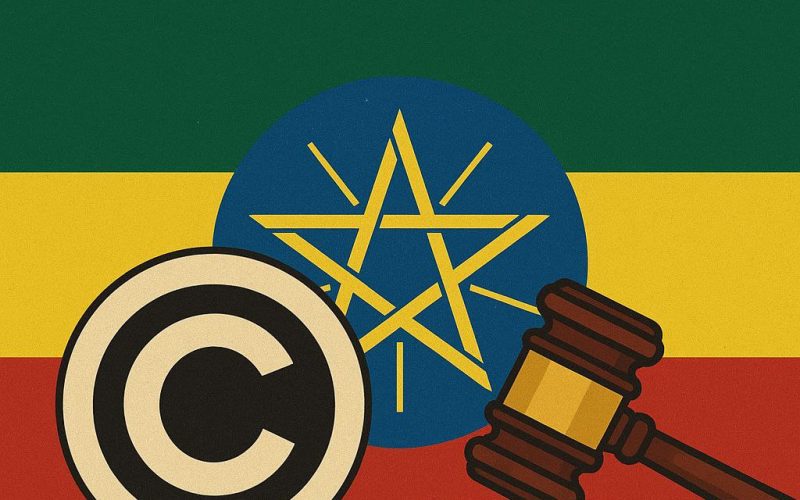
Ethiopia to Revise Copyright Law Amid Rising Digital Piracy
Ethiopian Musicians Association President Dawit Yifru, a veteran composer who has produced more than 200 musical works and poems, has urged authorities to strengthen the protection of artists’ creative rights.
Dawit, who recently received an honorary doctorate from Wolkite University in recognition of his contribution to Ethiopian music, told Ethio Negari that many singers, poets, and songwriters including himself are living in poverty due to the failure to enforce copyright laws that safeguard their intellectual property.
“Although Ethiopia has a proclamation approved by the House of People’s Representatives to ensure that creators benefit from their works, artists are still being robbed of their intellectual property,” Dawit said.
He explained that the lack of a directive to implement the existing Copyright and Related Rights Proclamation has left artists vulnerable.
As a result, the works of former and current musicians are being distributed freely across media and social platforms without proper authorization or payment.
Dawit stressed that although artists, including musicians, have organized themselves into professional associations and made various efforts to protect their interests, an enforcement directive is urgently needed to ensure their rights are respected.
He also noted that while platforms such as YouTube and other social media companies provide opportunities for content creators, they have failed to prevent widespread copyright violations. This, he said, continues to inflict financial and moral harm on Ethiopian artists.
MultiChoice Ethiopia, one of the major international entertainment companies serving Ethiopian audiences, has also expressed concern over copyright violations.
Demeke Kebede, the company’s Stakeholder and Media Relations Manager, said MultiChoice delivers content such as sports through SuperSport and movies and artistic works via M-Net on DStv.
Demeke explained that content theft including unauthorized broadcasts and online redistribution has become a growing challenge.
“Individuals are stealing or consuming stolen content, knowingly or unknowingly,” he said. “With the rapid advancement of digital technology, internet content is expanding, and since sports are a major form of entertainment globally, institutions like ours are suffering significant losses when content is pirated or streamed illegally.”
Demeke warned that such violations threaten companies that invest heavily in content production and distribution.
“If institutions that create jobs, pay taxes, and nurture talent fail to receive the profits they deserve, the damage will be even greater,” he said.
He added that MultiChoice Ethiopia collaborates with both local and international partners to provide sports and artistic content, but much of it is illegally screen-recorded or redistributed on websites and social media platforms.
“Ethiopia already has laws protecting creative rights,” Demeke noted. “The Ethiopian Media Act and the Intellectual Property Protection Act safeguard not only producers but also the content of media institutions.
The problem lies in enforcement. Our copyright laws must be updated to reflect today’s digital realities.”
Demeke called for the revision of existing copyright laws to address the theft of digital content, arguing that the current proclamation does not adequately cover online violations.
The Ethiopian Intellectual Property Authority (EIPA) confirmed that it is amending Proclamation No. 410/1996, which governs the protection of copyright and related rights for citizens and institutions.
Wesen Mulu, Head of the Authority’s Copyrights Department, said that although Ethiopia has an existing proclamation, creators have not benefited to the desired level.
“Studies show that Ethiopia is among the countries with the highest rate of internet content theft,” he said. “Our first priority is to make creators aware of their rights and to ensure that they can prove ownership of their works.”
Wesen explained that the Authority’s efforts focus on awareness creation, supporting enforcement, and ensuring that internet service providers (ISPs) take responsibility for removing pirated materials.
However, he acknowledged that Ethiopia currently lacks a law requiring ISPs to take down stolen content on their own initiative, making enforcement difficult.
“Although Ethiopia has laws to protect copyright and related rights, there are no implementation guidelines to ensure that creators and rights holders can fully benefit,” he said.
The Authority is also working to align national laws with international standards, strengthen institutions, and train personnel on new technologies to improve protection mechanisms.
“Many people today simply post or use other people’s creative works online without permission,” Wesen said.
“These are not creators they are infringers. It is our duty to build systems that protect real creators.”
Wesen noted that Proclamation No. 410/1996, which currently governs copyright and related rights, will be revised to reflect technological advancements, attract investment, and sustainably protect creative works.
The Authority, in collaboration with the Law Department of Addis Ababa University, has launched a comprehensive research project aimed at identifying key gaps in intellectual property protection and proposing modern solutions to curb violations.
The study, which began last year, is expected to conclude in the coming months with input from artists, associations, and various stakeholders.
Meanwhile, the Ethiopian Media Authority, in a study released last year, called on international social media and technology companies to open offices in Ethiopia.
The Authority argued that local presence would help curb fake news, hate speech, and copyright violations, while ensuring these companies pay taxes on their profits and comply with national laws.
The repeated concerns expressed by musicians, media companies, and government officials highlight a shared challenge: the gap between policy and practice.
Ethiopia’s creative community continues to play a vital role in shaping national identity and global culture. Yet without swift and effective enforcement of copyright laws, many of the nation’s most talented artists risk losing both their livelihood and legacy.
“Our creative works are our identity,” Dawit Yifru emphasized.
“Protecting them is not just about artists it’s about protecting Ethiopia’s cultural heritage.”
