
Ethiopia Calls for Dialogue and Regional Integration Amid Rising Tensions with Eritrea
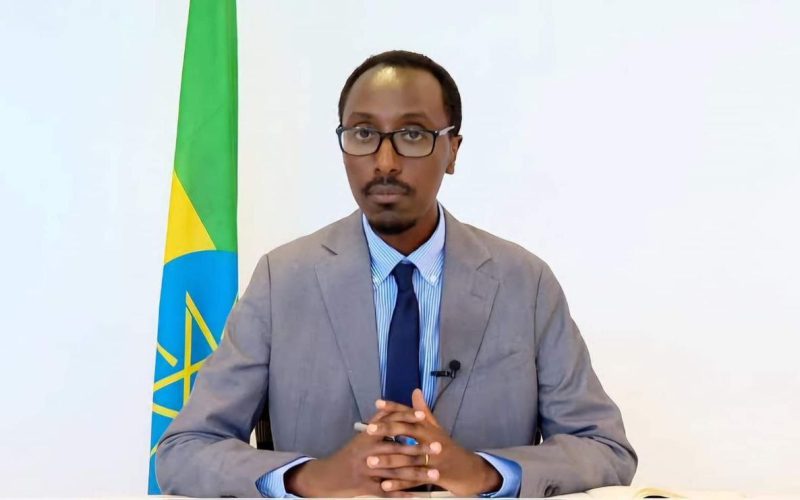
Ethiopia’s Foreign Minister, Gedion Timothewos, delivered a wide-ranging and strongly worded address on Friday at Addis Ababa University, outlining Ethiopia’s concerns over escalating tensions with Eritrea while presenting a long-term vision for peace, regional integration, and economic cooperation in the Horn of Africa.
Speaking at the Foreign Policy Forum organized by Addis Ababa University and the Horn Review, Gedion said the Horn of Africa is experiencing one of its most turbulent periods in recent history, with nearly every country facing serious security challenges despite the region’s vast development potential.
The Minister dedicated much of his nearly two-hour speech to Ethiopia’s strained relationship with Eritrea, describing it as a “perennial flashpoint” that has shaped the Horn’s political trajectory for more than 70 years.
He recounted the complex history between the two nations from federation and secession to multiple wars and an 18-year “no-war, no-peace” impasse arguing that conflict has been the rule rather than the exception.
Gedion accused Eritrea of consistently adopting a hostile posture toward Ethiopia, regardless of the government in power in Addis Ababa.
Citing findings from the Eritrea–Ethiopia Claims Commission, he reminded the audience that Eritrea was deemed the aggressor in the 1998 war.
Although Ethiopia initiated a rapprochement in 2018 and advocated internationally for Eritrea’s reintegration, Gedion said Asmara failed to reciprocate the goodwill.
Today, he noted, Eritrean forces occupy several localities inside Ethiopia, and Eritrea is providing material support to armed groups seeking to destabilize the country.
“These facts provide ample ground for the legitimate exercise of Ethiopia’s right to self-defense,” he said. “But Ethiopia has consciously chosen a restraint that cannot be indefinite and unconditional.”
Gedion outlined five core issues that he believes underpin the long-standing instability between Ethiopia and Eritrea.
He argued that Eritrea seeks the privileges of sovereignty without fully embracing its responsibilities, while simultaneously expecting to benefit economically and politically from Ethiopia.
He also accused Asmara of acting as a proxy for foreign powers intent on weakening Ethiopia. Another source of tension, he said, is the so-called “Isayas doctrine,” which assumes that Eritrea’s survival depends on Ethiopia remaining insecure and fragmented.
Gedion further highlighted the heavily militarized nature of the Eritrean state, which he described as prioritizing perpetual warfare over the welfare of its citizens.
Finally, he pointed to lingering Ethiopian grievances related to the circumstances of Eritrea’s independence and Ethiopia’s continued exclusion from the Red Sea issues that remain emotionally and strategically significant for many Ethiopians.
He added that Ethiopia’s need for secure maritime access is an “existential matter,” essential to supporting its growing population and long-term economic ambitions.
Despite the gravity of the current tensions, Gedion emphasized that Ethiopia remains committed to a peaceful future built on regional cooperation.
He outlined Ethiopia’s vision of the Horn as a single “geo-economic and cultural space,” with integrated infrastructure, trade, and investment, modeled on successful regional blocs elsewhere.
He argued that Ethiopia and Eritrea “two states with virtually one people” should form the nucleus of a Horn of Africa economic community.
Beginning with a Free Trade Area, the two countries could eventually harmonize policies, jointly develop strategic infrastructure, and secure durable access to the sea for Ethiopia.
“This model offers mutual benefit and a path toward long-term peace,” he said.
Gedion urged the international community to discourage Eritrea’s “spoiler role” and encourage constructive engagement.
“The world cannot afford another 30 years of conflict, poverty, and displacement in the Horn,” he warned, calling on global actors to pressure Eritrea to end its provocations and enter dialogue.
He concluded with an emotional appeal for Ethiopians and Eritreans especially the next generation to imagine a future beyond conflict.
“We cannot undo our painful history,” Gedion said. “But we can shape tomorrow. Ethiopia is ready for dialogue. The question is whether Eritrea will join us”, He added.
