
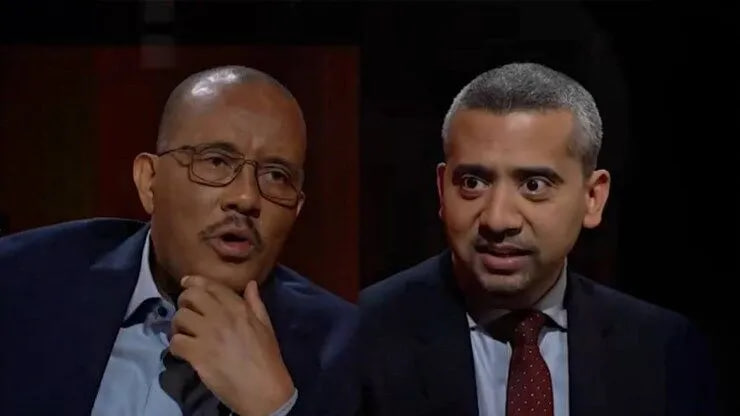
By Kebour Ghenna
Let us consider the scene, dear reader.
Here is a man, Getachew Redda, a political survivor of a caliber so rare it should be studied. He has navigated the treacherous currents of Ethiopian politics from the inner sanctum of the TPLF to the precarious role of interim president of Tigray, and now to a ministerial perch in the very government that waged a brutal war on his homeland. He is, by all accounts, a man who understands power, its whispers, its threats, its dark algebra.
And so, we are left with a puzzle. Why would such a man, a seasoned tactician in the art of political preservation, voluntarily walk into the studio of Mehdi Hassan, a journalist known not for conversation, but for intellectual vivisection?
It was the political equivalent of a surgeon requesting a procedure without anesthetic. It was, to the casual observer, madness.
But in the world of high-stakes politics, nothing is done without a calculation, however flawed. Getachew did not stumble into that interview. He chose it. He sat down, adjusted his microphone, and looked into the eyes of a man who makes a living by feeding hypocrisy to its owners.
What did he hope to win?
Perhaps he believed in the power of his own narrative. After a lifetime in the backrooms of revolution and government, maybe he thought he could master the story. He would present himself as the pragmatic statesman, the man who made difficult choices to stop the bleeding, who chose the lesser evil to save his people from a greater one. He would be the bridge, the realist in a room of idealists.
This is the vanity of all political men. They begin to believe their own press releases, their own carefully crafted justifications. They think that a complex history can be smoothed over with a few well-rehearsed lines about “process” and “the bigger picture.” They forget that a skilled interrogator, like Mehdi, does not deal in stories. He deals in facts, in dates, in a man’s own words thrown back at him like spears.
And what a trove of spears Getachew offered.
For the better part of an hour, the viewing public was treated to a spectacle of breathtaking contradiction. The former TPLF insider was confronted with the actions of the government he now serves. The man whose former comrades were labeled terrorists was now defending, or at least excusing, the alliance with their arch-nemesis in Asmara. The political chameleon was asked to explain how his stripes had changed so completely, yet his essence, his power, remained.
Mehdi Hassan, like a master archivist, pulled the files. He presented Getachew with his past selves, one after another. Here is what you said then. Here is what you do now. Explain the space between.
And the space between was a chasm of moral compromise, into which Getachew’s credibility tumbled, end over end.
He was asked about the terror in Tigray, the genocidal rhetoric, the sea of suffering that defines the modern Horn of Africa. He was asked about the fantastical claim of his current boss, Abiy Ahmed, to be a prophesied king. These are not questions of policy. They are questions of soul.
And the answers were a masterclass in evasion, a goulash of bureaucratic language that nourished no one. “The situation is complex…” “We are focused on peace…” “One must understand the context…”
Empty calories for a starving audience.
So we return, relentlessly, to our original question: Why? If the risk was so colossal, and the performance so disastrous, what was the prize?
There are only a few possibilities, each more troubling than the last.
Perhaps it was arrogance. The belief that his intellect and experience could outmaneuver a prepared journalist on a global stage. This is the gambler’s flaw, believing the next hand will reverse a lifetime of losses.
Perhaps it was desperation. A man in his position, straddling two worlds that despise each other, has no solid ground. He needs legitimacy. He craves the recognition that he is not a traitor to his past, but a savior of its future. He sought the stamp of approval from a tough interrogator, thinking that merely surviving the encounter would grant him gravitas. He misunderstood. Surviving a Mehdi Hassan interview is not the point; dominating it is. And he was not the dominator.
Or perhaps, and this is the most cynical and therefore most likely explanation, it was a message to a domestic audience. The interview was not for the BBC or for the international community. It was a signal to his new masters in Addis Ababa. See, he could say, I went into the lion’s den for you. I faced the toughest critic the West can offer and defended our position. I am your man. I am loyal.
In this reading, the humiliation was the point. The public flogging was a performance of loyalty, a ritual sacrifice of his own reputation on the altar of his new political survival.
If that is the case, then the interview was not a failure. It was a stunning success. He proved his utility as a shield, as a man willing to absorb the blows so his patrons would not have to.
But at what cost? He traded the last vestiges of his political soul for a few more months at the table. He demonstrated that in the highest echelons of power, truth is not a compass, but a currency to be spent, and principle is a country to which no one holds a passport.
Getachew Redda did not lose a debate. He provided a clinical demonstration of the moral vacuum that so often defines modern statecraft. He walked in a political figure and emerged a cautionary tale. He dared, and in daring, he revealed that for some men, the pinnacle of power is nothing but a beautifully gilded cage, and the keys were long ago thrown away.
Editor’s note: – views in the article reflect the views of the writer only!!
