
Ethiopia Plans ETB 288 Billion Treasury Bills Issuance in Third Quarter Auctions
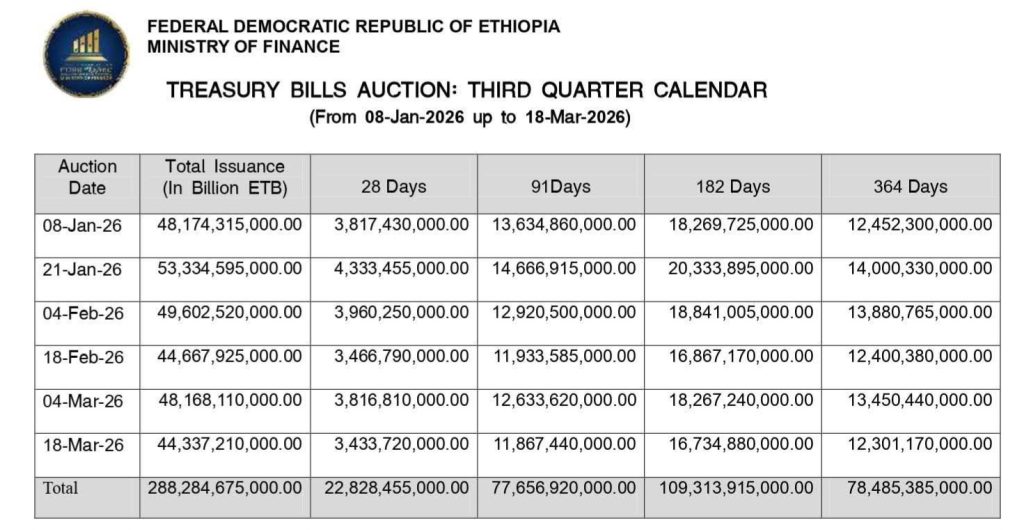
Ethiopia’s Ministry of Finance has announced a comprehensive Treasury Bills (T-bills) auction calendar for the third quarter of the 2025/26 fiscal year, outlining plans to raise ETB 288.28 billion between early January and mid-March 2026.
According to the official schedule, auctions will be conducted on six dates—January 8, January 21, February 4, February 18, March 4, and March 18—offering investors a range of short-term government securities with maturities of 28 days, 91 days, 182 days, and 364 days.
The quarterly issuance plan underscores the government’s continued reliance on domestic debt instruments to finance public expenditure while managing liquidity in the financial system.
The largest share of issuance during the quarter will come from 182-day Treasury bills, amounting to ETB 109.31 billion, reflecting strong demand from financial institutions seeking medium-term, low-risk investment options.
This is followed by 364-day bills, with a planned issuance of ETB 78.49 billion, and 91-day bills, totaling ETB 77.66 billion.
Short-term 28-day bills account for the smallest portion of the issuance, with ETB 22.83 billion planned across the six auctions.
On an auction-by-auction basis, the largest single issuance is scheduled for January 21, 2026, when the Ministry plans to raise ETB 53.33 billion, while the smallest issuance ETB 44.34 billion is set for March 18, 2026.
Treasury bills remain a cornerstone of Ethiopia’s domestic financing strategy, enabling the government to cover short-term funding needs without resorting to external borrowing.
The Ministry of Finance has repeatedly emphasized the importance of T-bills in maintaining fiscal discipline while ensuring predictable financing for priority public programs.
Economists note that the consistent scheduling of auctions improves market confidence and allows banks and institutional investors to better plan their liquidity management.
“Regular T-bill auctions are essential for stabilizing the domestic debt market and supporting monetary policy operations,” said a senior banking sector analyst.
“They also offer a risk-free investment avenue for financial institutions operating in a high-inflation environment.”
Treasury bills in Ethiopia are primarily purchased by commercial banks, insurance companies, pension funds, and other institutional investors, though recent financial sector reforms have aimed to broaden participation and enhance market competitiveness.
The National Bank of Ethiopia (NBE), which conducts the auctions on behalf of the Ministry of Finance, has been working to strengthen the T-bills market as part of wider efforts to modernize the country’s monetary policy framework.
The third-quarter auction plan comes amid ongoing macroeconomic reforms aimed at improving fiscal sustainability, managing inflationary pressures, and enhancing domestic revenue mobilization.
With limited access to external financing, domestic borrowing through instruments such as Treasury bills continues to play a vital role in funding government operations.
Market observers will be closely watching yield trends and subscription levels during the quarter, particularly as liquidity conditions in the banking sector remain tight and demand for government securities continues to evolve.
