
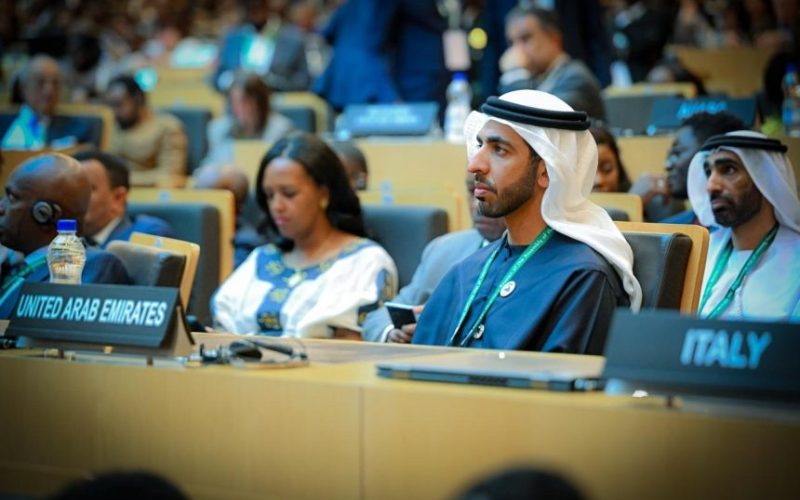
The United Arab Emirates is deepening its economic and development support to African countries, with officials highlighting more than $110 billion in investments committed across the continent in the past five years, much of it targeting energy, infrastructure and trade.
The scale of that support was underscored during the recent summit of the African Union in Addis Ababa, Ethiopia, where Sheikh Shakhbout bin Nahyan Al Nahyan represented the UAE and reaffirmed his country’s long-term commitment to Africa’s growth and stability.
On the sidelines of the meeting, the minister held talks with African officials and conveyed greetings from UAE leaders, including President Sheikh Mohammed bin Zayed Al Nahyan, Prime Minister Sheikh Mohammed bin Rashid Al Maktoum, and Vice President Sheikh Mansour bin Zayed Al Nahyan, expressing support for the prosperity and progress of AU member states.
Speaking at the summit, Sheikh Shakhbout said UAE-Africa relations are rooted in decades of commercial and maritime links across the Red Sea and the Indian Ocean.
He noted that those ties are now reflected in a growing diplomatic network, with 19 UAE embassies in sub-Saharan Africa and increasing African representation in the Gulf state, reinforcing the UAE’s role as a hub for trade, finance and dialogue.
He also reiterated support for AU development goals and closer cooperation with the African Union Commission in trade, renewable energy, food security, digital transformation and capacity building.
Energy has become a cornerstone of UAE support to Africa. Of the more than $110 billion invested between 2019 and 2023, over $70 billion has gone to energy and renewable projects, reflecting a view that electricity access is essential for industrialization and diversification.
Clean energy is a major focus. The Africa Green Investment Initiative has mobilized billions of dollars for solar, wind, geothermal, storage and green hydrogen projects.
UAE firm Masdar is advancing a $10 billion Africa program, while the Etihad 7 initiative targets expanded electricity access for up to 100 million people by 2035.
Water security and climate resilience are also rising priorities. The UAE plans to co-host the 2026 UN Water Conference with Senegal, with a focus on improving water access and sanitation key development challenges across Africa.
Beyond energy, the UAE is strengthening Africa’s trade links. It has concluded comprehensive economic partnership agreements with nine African countries Nigeria, Democratic Republic of the Congo, Sierra Leone, Gabon, Angola, Kenya, Republic of the Congo, Mauritius and the Central African Republic.
Officials say these deals extend to services, digital trade and investment protection and are intended to complement the African Continental Free Trade Area.
In logistics, DP World is expanding port infrastructure, including a $1 billion upgrade of the Port of Dar es Salaam in Tanzania.
Meanwhile, AD Ports Group has launched a new terminal project in Luanda, boosting Angola’s container capacity.
Support also extends to aid. Nearly 40% of the UAE’s foreign assistance over the past decade about $20.9 billion has gone to African countries in the form of development and humanitarian funding.
Taken together, the UAE’s investments, trade deals, infrastructure projects and aid flows point to a sustained strategy to support Africa’s development while deepening economic ties.
As African countries pursue integration and sustainable growth, the Gulf nation is positioning itself as a long-term partner in the continent’s transformation.
