
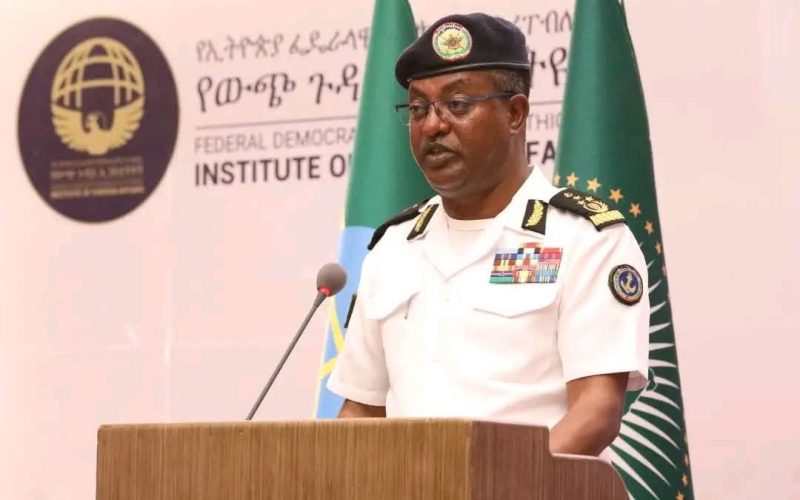
Vice Admiral Kindu Gezu of the Ethiopian National Defense Force (ENDF) has called for inclusive and cooperative maritime governance in the Red Sea and Gulf of Aden, warning that growing security and economic challenges in the region require collective action beyond narrow alliances.
Opening the fourth Red Sea–Gulf of Aden (RESGA IV) Dialogue in Addis Ababa, the navy commander said the region remains a vital artery for global trade and energy transport but is increasingly threatened by maritime crime, geopolitical tensions, and economic competition.
“No single nation can tackle the myriad challenges posed by maritime crime, arms trafficking, illegal trade, and migration,” Kindu said, stressing the need for broader regional and international cooperation.
He noted that recent disruptions in key maritime chokepoints have exposed vulnerabilities in global supply chains, disproportionately affecting developing and landlocked countries such as Ethiopia.
According to the vice admiral, such incidents underscore the urgency of building an inclusive governance framework that reflects shared interests.
Kindu emphasized that effective maritime governance must involve a wide range of stakeholders, including coastal and landlocked states, local communities, and international partners.
He added that inclusivity enhances both legitimacy and coordination in addressing shared security and economic concerns.
Highlighting the importance of connectivity, he called for increased investment in ports, transport infrastructure, and digital maritime systems, alongside improved data-sharing and rescue coordination mechanisms.
These measures, he said, are essential to ensuring sustainable economic growth and regional stability.
The vice admiral also reiterated Ethiopia’s long-standing position on securing sovereign access to the Red Sea, describing it as a “legitimate quest” driven by economic necessity and strategic considerations.
He argued that lack of direct access has limited Ethiopia’s economic opportunities and diminished its regional influence.
Meanwhile, Jafar B. Geletu, Executive Director of the Ethiopian Institute of Foreign Affairs, underscored the importance of inclusivity in regional governance, warning that existing frameworks have failed to deliver stability due to their exclusionary nature.

In his welcome address, Jafar pointed to recent attacks on commercial vessels in the Bab el-Mandeb Strait, which forced shipping companies to reroute around the Cape of Good Hope, significantly increasing costs and delays.
He said the impact was felt far beyond coastal states, affecting inland economies through higher import prices and disrupted supply chains.
“When the moment demanded a collective response, the region discovered something troubling key stakeholders were not at the table,” he said. “Security was coordinated among a few, but the consequences were shared by all.”
Jafar argued that the Red Sea should be viewed not as a dividing line but as a bridge connecting the Horn of Africa and the Gulf region.
He highlighted growing economic interdependence, including energy flows, trade under the African Continental Free Trade Area (AfCFTA), and Gulf investment in African markets.
He called for building governance structures that reflect these realities, enabling cooperation in trade, energy, and security across the region.
“Shared waters demand shared stewardship,” he said, adding that dialogue remains essential to preventing conflict and fostering mutual understanding.
The RESGA IV Dialogue brings together government officials, diplomats, experts, and stakeholders from across the Horn of Africa, the Gulf, and beyond to discuss maritime governance, security, and economic cooperation.
Both speakers agreed that the future stability and prosperity of the Red Sea region will depend on inclusive, rules-based governance that accommodates the interests of all stakeholders.
