
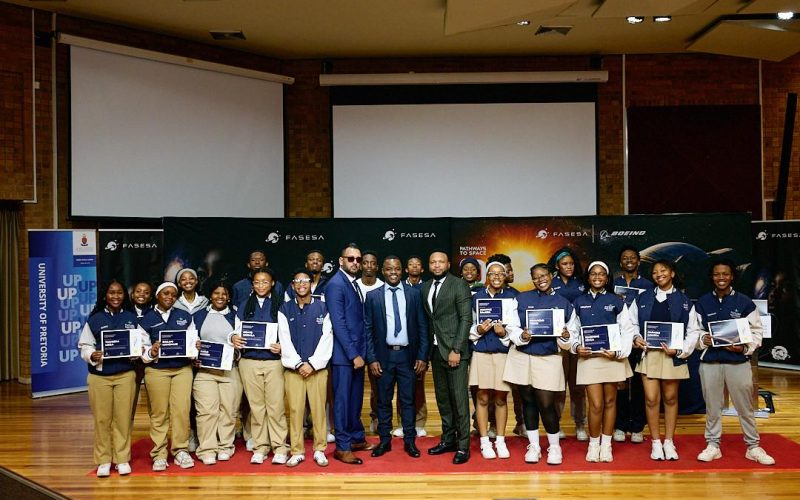
A total of 832 Ethiopian students have graduated from the third annual Pathways to Space program, an initiative aimed at developing the next generation of African aerospace and space science professionals.
The program, jointly organized by the Future African Space Explorers STEM Academy (FASESA) and Boeing, graduated 2,626 students across Ethiopia, Kenya, Nigeria and, for the first time, South Africa this year.
Over a five-month period, participants studied astronautics, systems engineering, human factors and materials science through practical projects. The program also included a high-altitude balloon mission designed to strengthen students’ data-analysis skills.
The 2026 program introduced a new Space Suit Design Challenge, in which students developed prototype spacesuit concepts while tackling challenges related to pressurization, thermal control, radiation reduction and human ergonomics.
Dr. Bethelhem Nigussie, Deputy Director General of Ethiopia’s Space Science and Geospatial Institute (SSGI), said the performance of Ethiopian students in the spacesuit challenge demonstrated the potential of young Africans to contribute to the continent’s space science sector.
She said SSGI is committed to strengthening its partnership with FASESA and Boeing, describing the collaboration as an effort to build a foundation for Africa’s future astronauts, satellite engineers and space innovators.
The students also participated in virtual sessions with former astronauts and space professionals from NASA’s Johnson Space Center, Final Frontier Design and leading universities. Among the speakers were Professor Jeff Volosin of Capitol Technology University and Dr. Andrew Abercromby, a biomedical engineer and former NASA Extreme Environment Mission Operations (NEEMO) aquanaut.
FASESA Managing Director Sean Jacobs said the program goes beyond academic qualifications by preparing students to address real-world challenges. According to Jacobs, one graduate was selected to participate in Mission ShakthiSAT, an international all-women-led lunar mission, while another designed a parabolic-grid radio telescope.
The 2026 cohort comprised 1,313 students from South Africa, 832 from Ethiopia, 431 from Nigeria and 50 from Kenya.
Since its launch in 2024, the Pathways to Space program has reached nearly 3,500 students across Africa. The initiative comes as African governments and national space agencies expand activities in Earth observation, remote sensing, communications and satellite services, increasing demand for skilled professionals in the sector.
Boeing said it has invested $14.5 million in partnerships with African universities and nonprofit organizations over the past decade. More than 58,500 people have participated in Boeing-supported STEM and workforce development programs across the continent during the last five years.
