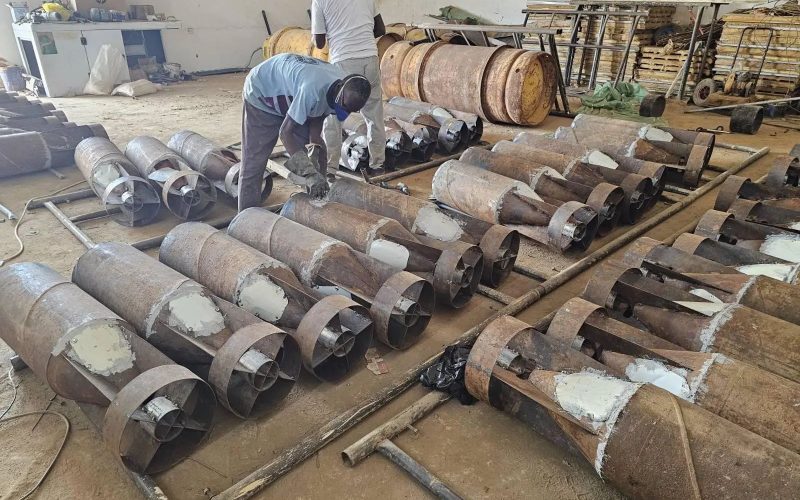
A substance used daily to make drinking water safer now appears at the heart of one of the most serious files linked to the Sudanese war. The documents published by American media outlets regarding the army’s alleged chemical program do not only discuss the manufacturing of chlorine bombs, but also open a more complex question: where did the chlorine come from?
The materials reviewed by The Washington Post reveal more than one alleged route for obtaining it, including drinking water treatment facilities and a shipment said to have entered Sudan via Egypt. One account discusses the arrival of 20 chlorine tanks via Egypt, a quantity the correspondence said was theoretically sufficient to produce about 1,100 munitions. At the same time, other recordings and materials indicate that cylinders were obtained from facilities designated for water treatment.
The documents highlight the Al-Manara water treatment station in Khartoum, one of the civilian facilities that received chlorine as part of international support to continue providing safe water to the population during the war, given that UNICEF confirmed it supplied chlorine to the Khartoum State Water Corporation between 2023 and 2025 for use in six stations, including Al-Manara. However, it stated clearly that its records contain no evidence that any quantity it supplied was diverted or misused, and that any other use would constitute a breach of the aid conditions.
Herein lies the sensitivity of the file: the documents do not prove that the chlorine supplied by UNICEF is what ended up in the alleged munitions, and the presence of the substance at a civilian station cannot be turned into an accusation against a humanitarian organization or proof of a diversion route.
But if an independent investigation establishes that materials designated for civilian infrastructure or water treatment were diverted to a military program, then the issue would extend beyond the source of the weapon to the integrity of aid supply chains and oversight of dual-use materials in war zones.
The account concerning the shipment arriving via Egypt likewise still requires independent investigation into its source, the nature of the shipment, the party that purchased it, and its route after entering Sudan. Thus, the significance of the documents lies not in proving a single source of chlorine, but in revealing two possible supply routes, each of which requires investigation: cross-border import, and access to stockpiles originally designated for water treatment.