
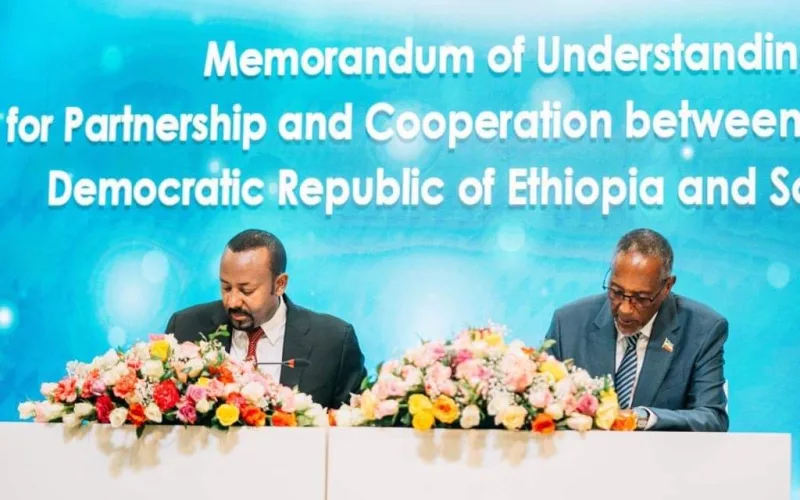
The recently announced port and naval base agreement between Ethiopia and Somaliland has sparked a new wave of diplomatic tension in East Africa.
Ethiopia, in its ongoing pursuit of a Red Sea port, revealed that it has secured a lease for a port from the self-governing region of Somaliland.
The memorandum of understanding (MoU) outlines that Ethiopia will gain access to both a port and a military base situated approximately 20 kilometers from the Berbera port in Somaliland.
In return, Ethiopia commits to recognizing Somaliland as a sovereign nation. Additionally, Somaliland will obtain a 20 percent stake in Ethiopian Airlines, with further negotiations scheduled within the next month.
In response to this agreement, Somalia has vehemently objected, asserting that the deal infringes on its territorial claims and violates international law, challenging its sovereignty.
Somalia argues that the Ethiopia-Somaliland agreement may impede its efforts to counteract Al-Shabaab, potentially leading to the resurgence of the terrorist group.
Somalia has declared its intention to take any necessary action to safeguard its sovereignty, rallying support and urging its citizens to be prepared.
President Hassan Sheikh Mohammed called for intervention from the African Union and the United Nations. He also engaged in discussions with Egyptian President Abdel Fattah al-Sisi and leaders of the Arab League, seeking their support. President Al-Sisi pledged support for Somalia’s sovereignty and unity.
On the international front, the European Union has voiced its support for the sovereignty and unity of Somalia, aligning with the position of the African Union.
Somaliland, which has functioned as an autonomous government for the past three decades, has persistently sought recognition as an independent nation from Ethiopia and the African Union.
In response to these developments, the U.S. Congress has approved a policy permitting military and diplomatic cooperation with Somalia.
Ethiopia plans to dispatch a diplomatic delegation to various Western countries to elucidate the specifics of its agreement with the self-governing region of Somaliland.
As the situation unfolds, the diplomatic landscape in East Africa is likely to see further complexities and shifts in alliances.
Prime Minister Abiy Ahmed had underscored the necessity for Ethiopia to have a sea gateway in a speech to the House of Representatives two months ago.
Following this, Ethiopia approached neighboring countries, including Somalia, Djibouti, and Eritrea, with requests for access to a Red Sea port.
Regrettably, Somalia, Djibouti, and Eritrea rejected Ethiopia’s appeals, prompting the nation to explore alternative options.
Somalia, while expressing willingness to collaborate with Ethiopia on various fronts, staunchly rejected the request to share its Red Sea port, emphasizing the non-negotiable nature of its sovereignty and territorial integrity.
Eritrea did not provide a direct response to Ethiopia’s request, but it conveyed dissatisfaction with ongoing talks related to water, sea access, and related matters.
The former Ethiopia’s part, Eritrea cautioned all parties involved to exercise caution in navigating these sensitive issues, highlighting the complexity of the discussions.
Djibouti, too, rebuffed Ethiopia’s request for a sea gateway. In response, Prime Minister Abiy Ahmed reiterated Ethiopia’s commitment to resolving the matter through peaceful means, emphasizing a lack of intent to resort to force.
In a previous initiative, the government led by former Prime Minister Hailemariam Dessalegn acquired a 19 percent ownership stake in the Berbera Port, located in Somaliland. However, this earlier deal did not come to fruition as anticipated.
