
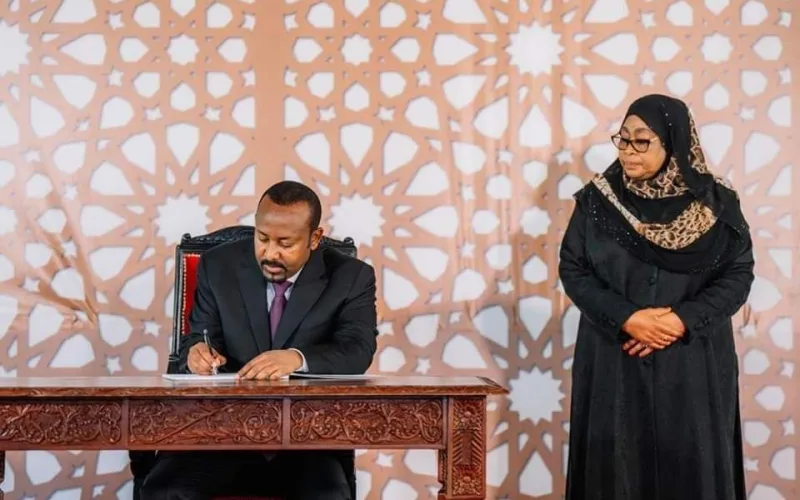
Prime Minister Abiy Ahmed paid a two-day official visit to Tanzania last week.
During his visit to Dar es Salaam, Prime Minister Abiy signed agreements on aviation cooperation and the sale of electric power with the government of President Samia Suluhu Hassan.
The spokesperson of the Ministry of Foreign Affairs, Ambassador Meles Alem, announced in his weekly diplomatic statement that Ethiopia has signed an agreement to sell 400 megawatts of energy to Tanzania.
Ethiopia has emphasized its commitment to energy and aviation diplomacy with neighboring countries, particularly highlighting its provision of training for pilots, air traffic controllers, and aviation experts to neighboring nations.
Ethiopia Electric Power (EEP) also disclosed Ethiopia’s ambitious plans to generate revenue amounting to 30 billion birr from the sale of electricity domestically and abroad in the current fiscal year.
Additionally, Ethiopia aims to export 3000 gigawatts of electricity to neighboring countries and earn $182 million during the same fiscal period.
Presently, Ethiopia is already selling electricity to three neighboring countries: Djibouti, Sudan, and Kenya. However, the revenue from electricity sales has faced challenges, notably due to Sudan’s inability to settle its $70 million debt amidst its civil unrest.
Despite these challenges, Ethiopia remains resolute in expanding its electricity exports to neighboring countries, with ongoing negotiations to further increase sales.
Ethiopian Electric Power has revealed plans for a feasibility study to explore the potential sale of electricity to South Sudan and Somalia, in addition to Tanzania.
Critics have raised concerns about the diversion of electricity to neighboring countries while a significant portion of the Ethiopian population lacks access to electricity.
Only 52 percent of Ethiopians currently have access to electricity, prompting questions about prioritization of domestic needs.
Ethiopian Electric Power defends its electricity exports by explaining that surplus power is sold during off-peak hours, particularly at night when domestic demand is lower.
Moreover, the revenue generated from electricity exports helps alleviate the foreign currency shortage faced by the government.
In efforts to meet growing energy demands, Ethiopia is nearing completion of Africa’s largest dam on the Nile River.
The dam, which is 95 percent complete, is designed to produce 5200 megawatts of electricity upon its full operation.
This project signifies Ethiopia’s commitment to addressing both domestic and regional energy needs while contributing to economic development and regional cooperation in East Africa.
