
Ethiopia Seeks to Host the 2029 Africa Cup of Nations: A Bold Request by Prime Minister Abiy Ahmed
Ethiopia has officially expressed its desire to host the 2029 Africa Cup of Nations (AFCON).
Prime Minister Abiy Ahmed made this request during the annual conference of the Confederation of African Football (CAF), held in Addis Ababa.
This announcement signals Ethiopia’s ambition to stage the prestigious continental tournament, despite facing significant infrastructural challenges.
During a dinner event at the National Palace for CAF officials and other prominent football leaders, Prime Minister Abiy Ahmed formally asked CAF to consider Ethiopia as the host nation for the 2029 AFCON.
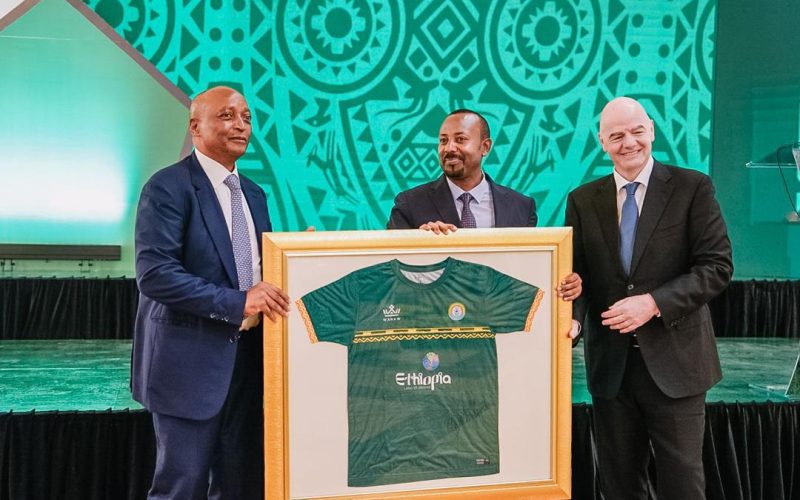
The request was made in the presence of FIFA President Gianni Infantino, CAF President Patrice Motsepe, and other key figures in the football world.
In his speech, CAF President Patrice Motsepe expressed gratitude for the warm Ethiopian hospitality. “The culture, values, and hospitality of Ethiopians made us feel at home,” he remarked.
He also acknowledged Ethiopia’s official request, stating that CAF would consult with the relevant committees to evaluate Ethiopia’s potential as a host for the 2029 tournament.
FIFA President Gianni Infantino also praised Ethiopia, describing it as the “birthplace of humanity” and affirming that it is “our country” in a symbolic nod to Ethiopia’s historical significance.
Despite Ethiopia’s enthusiasm, the country faces considerable hurdles in meeting the requirements for hosting a tournament of AFCON’s magnitude.
Currently, Ethiopia does not have any stadiums that meet CAF’s standards. This has forced the Ethiopian national football team to play qualifying matches outside the country.
CAF requires a minimum of six stadiums that meet international standards for a country to host AFCON.
Unfortunately, Ethiopia lacks the necessary infrastructure at present. The Adey Ababa Stadium, which is under construction in Addis Ababa and is expected to accommodate 62,000 spectators, has faced delays due to various reasons, and its completion date remains uncertain.
Ethiopia has one stadium in each region, but none are currently up to CAF’s standard. This lack of infrastructure could present a significant obstacle to the country’s bid, unless substantial improvements are made in the coming years.
Ethiopia has a deep historical connection to the Africa Cup of Nations. It was one of the founding members of the tournament and hosted the event in 1962. That year, Ethiopia won its only AFCON title, defeating Egypt in the final.
Though Ethiopia has struggled to replicate that success in recent years, hosting AFCON 2029 would provide the nation with an opportunity to not only reignite its football legacy but also boost its global sporting profile.
In a symbolic gesture during the conference, Prime Minister Abiy Ahmed presented the logos of the Ethiopian national football team to both FIFA and CAF presidents.
In return, FIFA President Gianni Infantino presented a signed football, marking the bid for the 2029 tournament. The exchange underscored Ethiopia’s commitment to football and its aspirations to be a key player in African sports once again.
Although Ethiopia faces significant infrastructural challenges, the country’s official bid to host AFCON 2029 represents a bold and ambitious vision for the future.
If successful, Ethiopia could once again take center stage in African football, hosting the continent’s most prestigious tournament nearly 70 years after its first victory.
The CAF committee’s decision on Ethiopia’s bid will be closely watched, as the country’s preparation efforts in the coming years will be critical to securing the right to host the Africa Cup of Nations in 2029.
