
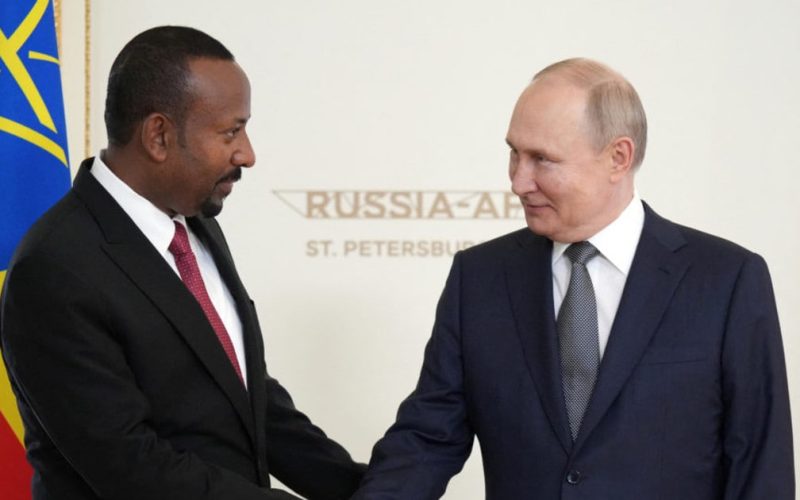
Russia Expands Non-Dollar Trade: Ethiopia, Nigeria, and Tunisia Sign On
Ethiopia, along with Nigeria and Tunisia, has reportedly reached an agreement with Russia to conduct trade transactions in their respective national currencies.
This move is part of Moscow’s broader strategy to establish non-dollar trade mechanisms in response to Western sanctions imposed following the war in Ukraine.
With the inclusion of Ethiopia, Nigeria, and Tunisia, the number of countries that have reached agreements with Russia to trade in their local currencies has now risen to 40, according to the Kremlin.
Several African nations, including Algeria, Egypt, Morocco, and South Africa, were among the first to receive approval from the Russian government in September 2023 for similar trade arrangements.
Additionally, trade representatives from Argentina, Cambodia, Laos, Mexico, Nigeria, Tunisia, and Ethiopia have been granted new licenses to conduct foreign currency transactions.
The Russian government has emphasized that these measures will enhance economic efficiency by addressing the country’s foreign exchange needs and facilitating direct currency exchanges with friendly and independent states.
The agreement is expected to help participating countries, including Ethiopia, alleviate foreign currency shortages in their trade dealings with Russia and strengthen bilateral economic relations.
Reports from Sputnik indicate that the Russian government has been actively seeking alternative trading mechanisms to counteract the impact of Western sanctions.
It is noteworthy that Russia has already established similar currency exchange agreements with China and India, both of which are regarded as significant economic and diplomatic partners.
These agreements followed restrictions on Russia’s access to the SWIFT international money transfer system.
Furthermore, BRICS member states have previously taken steps toward creating a robust financial system and a free trade network, including the introduction of their own currency frameworks.
However, the shift away from the US dollar in global trade has sparked tensions with Washington.
US President Donald Trump previously warned of imposing sanctions and a 100 percent tariff on countries attempting to reduce reliance on the dollar as the world’s primary reserve currency.
Ethiopia, which has long faced challenges related to foreign currency shortages, has been actively pursuing similar currency exchange agreements.
In July 2023, the country reached an agreement with the United Arab Emirates (UAE) to facilitate trade transactions using their respective national currencies, signaling Ethiopia’s broader strategy to diversify its international trade mechanisms.
The central banks of both countries have agreed to swap their currencies based on their current purchasing powers, amounting to 46 billion Ethiopian Birr and 3 billion UAE Dirhams.
The memorandum of understanding was signed in Addis Ababa, allowing the two nations to conduct transactions in Birr and Dirhams in addition to the US dollar.
The agreement was formalized by Mamo Mehretu, Governor of the National Bank of Ethiopia, and Khalid Mohamed Balama, Governor of the Central Bank of the United Arab Emirates.
