
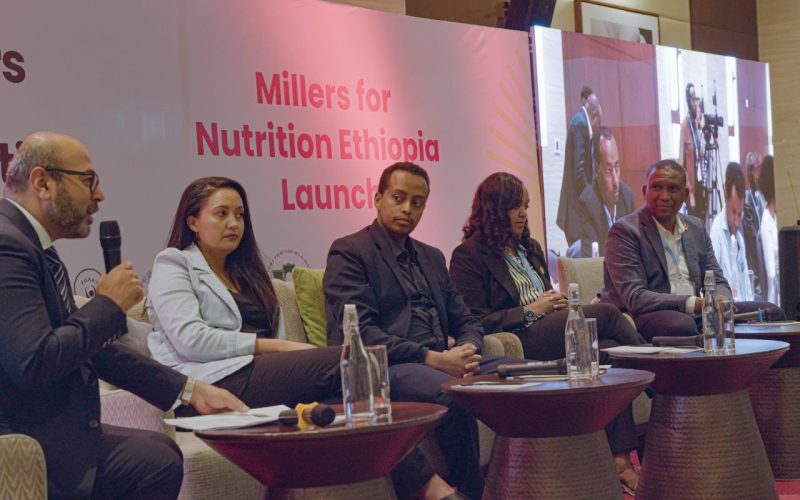
On December 3, 2024, Ethiopia witnessed a groundbreaking partnership as the Millers for Nutrition initiative is officially launched in Addis Ababa.
This collaboration brought together local millers, development partners, strategic fortification partners, and the Ethiopian government in a concerted effort to combat malnutrition and improve public health.
The initiative marks a significant milestone in the country’s ongoing battle against malnutrition, bringing together key players from both the public and private sectors to enhance the nutritional quality of staple foods.
Ethiopia has made substantial progress in addressing malnutrition, particularly through legislation. On August 31, 2024, the Ministry of Industry (MoI) rolled out the mandatory National Food Fortification Program, a crucial step in the country’s nutrition policy.
This program mandates the fortification of essential foods, including edible oil, wheat flour, and salt, for both locally produced and imported products. Additionally, Ethiopia implemented mandatory salt iodization in 2011, achieving an impressive 97% population coverage.
The Millers for Nutrition initiative, spearheaded by TechnoServe and supported by key strategic fortification partners such as BASF, dsm-firmenich, Hexagon, Mühlenchemie, SternVitamin, and Piramal, aims to complement government efforts by empowering local millers with the necessary tools, knowledge, and resources.
This will enable them to improve the nutritional quality of staple foods through fortification. Other ecosystem partners, including BioAnalyt and Sanku, along with regional and local organizations, will also play vital roles in supporting this initiative.
This public-private partnership approach aims to create a sustainable environment in which fortified foods become the norm, ensuring that all Ethiopians have access to essential nutrients for a healthier future.
The initiative’s multi-faceted strategy includes capacity building through tailored training and technical support, improving business practices, and ensuring compliance with fortification standards.
By fostering collaboration across government bodies, private sector organizations, and development agencies, the program will help create an enabling environment for fortification efforts.
Furthermore, the initiative will celebrate and recognize the achievements of local millers through national and international platforms, supporting their efforts to scale operations and ensure that fortified products are both widely accessible and affordable.
Eyakem Amsalu, the Millers for Nutrition Program Manager for Ethiopia, emphasized the importance of the public-private partnership in the program, stating, “The launch of Millers for Nutrition exemplifies our commitment to empowering local millers through strong public-private partnerships.
By bringing together millers, government officials, and experts, we are creating a lasting solution to malnutrition. By working together, we can ensure that every loaf of bread and bottle of oil is packed with the nutrients Ethiopians need to thrive.
This is not only beneficial for public health but also for business growth.” Amsalu further highlighted how this collaborative approach will improve nutrition, drive economic growth, and enhance public health outcomes across Ethiopia.
The Millers for Nutrition initiative is part of a broader global effort, spanning eight countries across Africa and Asia.
With the support of regional and international partners, and the commitment of local millers, the program is poised to make a lasting impact on Ethiopia’s nutritional landscape, contributing to improved public health and economic prosperity.
The initiative’s global goal is to improve nutrition for 1 billion people by 2026, underscoring the transformative potential of this public-private partnership in addressing malnutrition, one of Ethiopia’s most pressing public health challenges.
The coalition is powered by TechnoServe and funded by the Gates Foundation. Micronutrient deficiencies currently affect 3 billion people worldwide, leading to severe and long-lasting health issues.
Fortifying staple foods is one of the most scientifically proven and cost-effective solutions to tackling malnutrition on a large scale. However, this method remains underutilized, and initiatives like Millers for Nutrition seek to address this gap.
According to the Global Nutrition Report, Ethiopia is “on course” to meet one target for maternal, infant, and young child nutrition (MIYCN).
However, no progress has been made toward reducing anemia among women of reproductive age, with 23.9% of women aged 15 to 49 years now affected. Furthermore, there is insufficient data to assess Ethiopia’s progress in achieving the low birth weight target.
While some progress has been made toward exclusive breastfeeding, with 58.8% of infants aged 0 to 5 months exclusively breastfed, challenges remain.
Stunting continues to affect 36.8% of children under 5 years, which is higher than the average for the Africa region (30.7%), and wasting affects 6.8% of children, also higher than the regional average of 6.0%.
While Ethiopia has made strides in preventing the rise of overweight children under 5 years (currently at 2.3%), progress in addressing diet-related non-communicable diseases (NCDs) remains limited. Currently, 8.5% of adult women and 2.4% of adult men are living with obesity.
The Ethiopian Ministry of Health has also launched the Seqota Declaration (SD), a high-level commitment to eradicate malnutrition in the country.
The SD, launched in July 2015, aims to end stunting in children under two years of age by 2030. It follows a 15-year roadmap, building on the National Nutrition Program and the National Food and Nutrition Policy.
The SD is being implemented in three phases: the Innovation Phase (2016-2020), the Expansion Phase (2021-2025), and the National Scale-Up Phase (2026-2030), which will see evidence-based multi-sectoral interventions implemented across the entire country.
