
Ethiopia Passes Law Granting Broad Legal Immunity to Crime Investigators
The House of People’s Representatives has passed a controversial new law granting special privileges to investigators involved in probing money laundering and terrorism financing cases.
The legislation, part of a broader proclamation aimed at preventing and controlling such crimes, exempts investigators from criminal liability for any offenses committed during undercover operations—except for murder—if those offenses occur under duress and beyond their control.
The new proclamation, officially titled The Proclamation to Prevent and Control Money Laundering and Terrorism Financing, aims to strengthen Ethiopia’s legal framework in line with international anti-terrorism and anti-money laundering standards.
However, its provisions have sparked significant debate among lawmakers and civil society observers.
According to the proclamation, any individual authorized to conduct undercover investigations will not be held criminally liable for any actions taken during their assignment—so long as those actions are involuntary and committed under duress—except in the case of murder.
This immunity, supporters argue, is essential to allow investigators to perform high-risk tasks without fear of legal reprisal.
Dr. Alemu Gonfa, a council member, expressed mixed feelings about the law. While he acknowledged the necessity of strong legal tools to combat terrorism, he questioned the ethical implications of granting near-total immunity.
“The proclamation says a person shall not be held accountable for a crime committed under duress, except for murder. But if someone admits they committed a crime—even under pressure—it doesn’t seem right to absolve them entirely. It risks giving people unchecked power under the cover of legality,” Dr. Alemu stated.
Other members of the House voiced deeper concerns about potential misuse of the law.
MP Muluken Assefa warned that the proclamation could infringe on fundamental rights, including freedom of expression and political participation.
“As a political opponent, I fear this law could be used to target investors, journalists, human rights defenders, and public figures. The fact that it applies retroactively over a 10-year period makes it even more troubling. Laws should take effect from the day they are issued, not target the past,” he argued.
Similarly, Dr. Desalegn Chane criticized certain provisions that, in his view, grant overly broad powers to authorities.
He cited the clause allowing the Financial Security Service to freeze any “suspicious” financial transaction for up to seven days without a court order as an example of judicial overreach.
“This could mean investigators are not held accountable even if they commit acts like torture or serious human rights violations. How does this align with Ethiopia’s obligations under international law?” Dr. Desalegn questioned
In contrast, some members of the council defended the legislation. Mr. Zekarias, another council member, denied accusations that the law aims to suppress dissent or silence the media.
Mr. Sadiq Adem strongly supported the proclamation, stressing that the nation is facing a serious threat from terrorism and must respond accordingly.
“Our region is not safe. Terrorism is widespread. This law is necessary, and yes, it is severe—but justifiably so. No right is absolute—not even the right to life. National security must come first,” he argued.
He dismissed claims that the law was designed to target political opponents or journalists, insisting that it was crafted to protect the public from genuine threats.
“This proclamation is not for the people we fear hypothetically, but for those who pose real, ongoing threats. If any party meets the legal requirements, they will not be affected. We shouldn’t fear protecting our nation from known dangers,” Mr. Sadiq added.
In response to the criticism, Mr. Issa Boru, Deputy Chairman of the Standing Committee on Law and Justice Affairs, emphasized that the proclamation is meant to support law enforcement operations in complex criminal environments and was not designed to target specific groups.
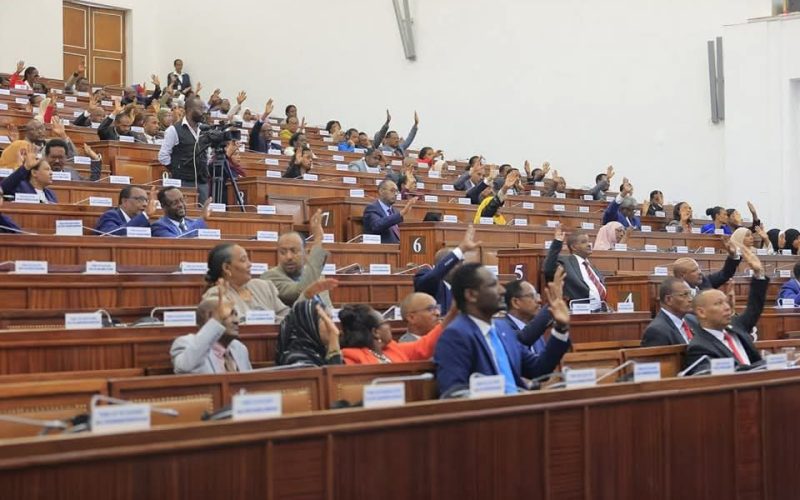
After extensive debate during its regular session, the council approved the proclamation with a majority vote. Three members voted against the bill, and one abstained.
