
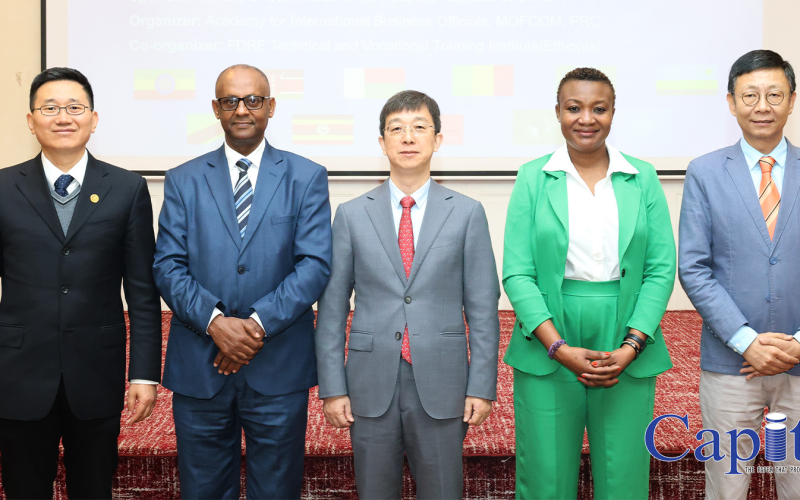
Ethiopia Hosts Africa-China-UNIDO Seminar on Vocational Education and Skills for Industrial Transformation
Ethiopia this week hosted the Overseas Seminar on Vocational Education Management Capacity Building for the Luban Workshop, bringing together educators, policymakers, and development partners from across Africa, China, and the United Nations Industrial Development Organization (UNIDO).
The event, held at Ethiopia’s Federal Technical and Vocational Training (TVT) Institute, marked a major step in advancing skills development and industrial cooperation under the China-Africa-UNIDO Tripartite Partnership.
The seminar, attended by representatives from 17 African nations, focused on expanding vocational education programs that align with Africa’s industrial priorities while strengthening South-South cooperation.
The Luban Workshop initiative—named after the ancient Chinese master craftsman Luban—has emerged as a flagship platform for building Africa’s technical capacity in fields ranging from robotics and automation to ICT and renewable energy.
In his opening address, Dr. Biruk Kedir of Ethiopia’s Federal TVT Institute emphasized Ethiopia’s commitment to the initiative, describing it as a “catalyst for African-led technological sovereignty.”
He noted that thousands of Ethiopian youth had already benefitted from training in advanced manufacturing, skills now applied in industrial parks across the country. “This capacity-building program responds to Africa’s most pressing challenge: translating industrial ambitions into sustainable local expertise,” Dr. Biruk said.
Representing the African Union Commission, Ms. Sophia Ndemutila Ashipala, Head of the Education Division, underscored the seminar’s alignment with the AU’s newly adopted Continental Technical and Vocational Education and Training (CTVET) Strategy 2025–2034.
She warned that Africa faces urgent employment challenges, with over 121 million youth classified as unemployed or not in education, employment, or training (NEETs) in 2025, and millions entering the job market annually with limited opportunities.
“These figures are not just statistics, but a call to action,” Ashipala said, highlighting the role of partnerships like the Luban Workshop in equipping Africa’s youth with green, digital, and technical skills.
She also invited partners to engage in the upcoming Africa Skills Week 2025, to be held in Addis Ababa in October under the theme “Powering Africa’s Industrial Future: Skills for Innovation, Growth, and Sustainability.”
Delivering remarks on behalf of China, Ambassador Jiang Feng, Head of Mission of China to the African Union, praised the deepening ties between China and Africa in vocational education, industrialization, and human capital development.
He recalled that during the 2024 Beijing Summit of the Forum on China-Africa Cooperation (FOCAC), President Xi Jinping had pledged to build 10 additional Luban Workshops in Africa, alongside expanding the “Future Africa Vocational Education” program.
“The training seminar initiated today is a practical measure to implement President Xi’s commitments within the framework of the China-Africa-UNIDO Cooperation Demonstration Center,” Jiang said, stressing that talent cultivation and technical skills are at the heart of modern international competition.
He added that China has already trained more than 100,000 African professionals in various fields over the past decades.
From Kenya, CPA Cecelia Ndunge, representing Meru University of Science and Technology’s Luban Workshop, highlighted the direct impact of such initiatives. Established in partnership with Tianjin City Vocational College, the Meru program specializes in ICT, Data Science, and E-commerce. “Vocational education is the heartbeat of Africa’s transformation,” she said. “If we empower our young people with the right skills, we empower our nations to grow, innovate, and compete globally.”
The Luban Workshops, now established in multiple African countries, provide advanced teaching equipment, technical training, and teacher certification programs.
They also aim to build strong links between academia and industry, ensuring that Africa’s growing youth population is equipped with market-ready skills.
Participants of the Addis Ababa seminar agreed that the Luban Workshop model—combining China’s technical expertise, Africa’s development priorities, and UNIDO’s international support—has the potential to become an African Skills Accelerator Network, driving industrial growth, technological innovation, and sustainable employment across the continent.
