
Rich Nations Provide Just 4% of Climate Funds Needed by East Africa – Oxfam
East African countries are receiving only a fraction of the climate financing they require to cope with worsening droughts, hunger, and water shortages, according to a new report by Oxfam and the Intergovernmental Authority on Development (IGAD).
The report, released ahead of the Second African Climate Summit (ACS2) in Addis Ababa, reveals that the eight IGAD countries – Djibouti, Eritrea, Ethiopia, Kenya, Somalia, South Sudan, Sudan, and Uganda – received an average of just $1.7 billion a year in climate-related grants and loans between 2013 and 2022.
This is 96% less than the $41.8 billion the countries estimate they need annually to implement their national climate action plans until 2030.
Although donor countries report sending $2.3 billion annually, much of this is in the form of loans, which Oxfam says are worsening the region’s debt crisis.
The true value of climate support – known as “grant equivalents” after accounting for interest and repayments – is significantly lower.
“Rich polluting nations set the planet on fire, then sit back and send water droppers to Majority World countries to put it out,” said Oxfam in Africa Director Fati N’Zi-Hassane. “They must take responsibility for the damage they are causing and adequately fund climate action.”
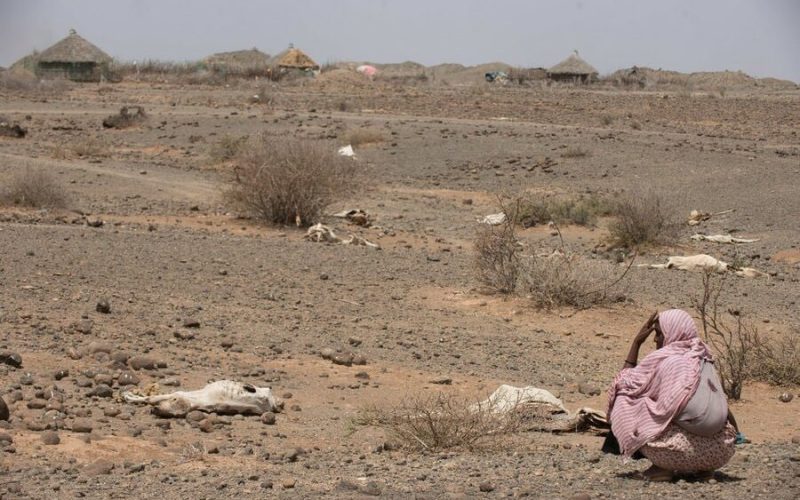
The shortfall in funding comes as the climate crisis continues to take a devastating toll across East Africa. In 2024 alone, an estimated 63.3 million people across seven of the eight IGAD countries faced severe hunger, underscoring the scale of the crisis.
At the same time, 126.7 million people—equivalent to 40 percent of the region’s population—remain without access to safe drinking water, forcing communities to rely on unsafe and unreliable sources.
Humanitarian appeals have also grown sharply in recent years. During the hunger crisis, funding requests nearly doubled, rising from $3.1 billion in 2021 to $6.1 billion in 2023.
Yet, despite the escalating needs, less than half of the requested resources were delivered in most years, leaving millions of vulnerable people without adequate support.
Communities are bearing the brunt of these shortages. “We walk up to seven kilometers to access water from shallow wells, sometimes with children on our backs. We draw water from the same spots where wild and domestic animals also drink from, and it is dirty and rarely sufficient,” said Joyce Achap, a resident of Turkana County, Kenya. “Diarrhoea and other waterborne diseases are rampant here.”
Despite agriculture, water, and sanitation being the sectors most affected by climate change, they received only 29% of climate-related development finance in the IGAD region.
Meanwhile, just over half of the funds (54%) were directed toward helping communities adapt to the crisis.
Women, who are disproportionately impacted due to existing gender inequalities, remain overlooked in a large share of projects. According to the report, 41% of funds sent to the region did not take women’s specific needs into account.
Countries facing fragility or conflict are especially marginalized: Eritrea and Somalia received climate finance covering only 1% and 2% of their needs, respectively.
Oxfam and IGAD argue that donor countries must overhaul the climate finance system to make it more accessible to local communities and organizations.
Currently, more than 80% of funds go to national governments and large institutions, leaving grassroots actors sidelined.
“Rich, polluting nations have an obligation to provide sufficient climate finance as per the international agreements they signed,” said N’Zi-Hassane. “With adequate funds that respond to the needs of women and local communities, Africans can build climate-resilient food systems, provide safe water, and have a better chance of bouncing back whenever disasters strike.”
