
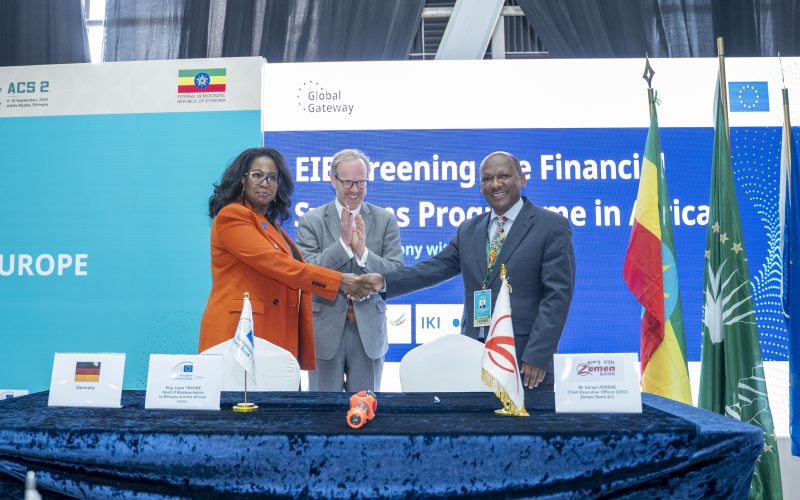
Ethiopian Banks Partner with EIB Global to Boost Climate Resilience and Green Finance
In a landmark move to strengthen Ethiopia’s financial sector against climate-related risks, the European Investment Bank’s development arm, EIB Global, has signed technical assistance agreements with three major Ethiopian banks: Zemen Bank, Dashen Bank, and Hibret Bank.
Announced on the sidelines of the Africa Climate Summit currently underway in Addis Ababa, the agreements aim to help these banks integrate climate risk assessment and sustainability principles into their operations.
This includes building capacity to manage climate-related financial risks, assess the impact of global climate policies on local businesses, and support investments that enhance resilience to extreme weather events such as floods and droughts.
The initiative is the first of its kind in Ethiopia and is part of the Greening Financial Systems (GFS) programme, led by the EIB and funded by Germany’s International Climate Initiative (IKI).
The project also works closely with the NDC Partnership, aligning with Ethiopia’s Long-Term Low Emission Development Strategy, which targets a net-zero economy by 2050.
The technical assistance will enable the three banks to align with Ethiopia’s green development goals by incorporating climate considerations into their lending decisions.
The programme also supports the expansion of green financing products, helping financial institutions design advisory services and sustainable lending strategies.
“This initiative is a significant step in equipping the bank’s team with the knowledge and tools needed to identify, assess, and manage climate risks effectively,” said Asfaw Alemu, CEO of Dashen Bank.
He added that the partnership would also support green financing opportunities that contribute to sustainable development.
Dereje Zebene, CEO of Zemen Bank, noted that the support will help the bank meet new national sustainability standards, including mandatory disclosures outlined in Ethiopia’s recently introduced Corporate Governance Directive.
Negusu Gebre Egziabeher, CEO of Hibret Bank, highlighted the importance of integrating Environmental, Social, and Governance (ESG) principles into the bank’s long-term strategy.
“This cooperation is a demonstration of our commitment to ESG and the principles of ethical banking,” he said.
The new partnerships come shortly after EIB Global signed a Memorandum of Understanding with the National Bank of Ethiopia (NBE) to support the country’s green finance transition.
The MoU includes work on a national green taxonomy, a framework that guides investments toward environmentally sustainable economic activities.
Leyla Traoré, EIB’s Head of Representation to Ethiopia and the African Union, emphasized the pivotal role of financial institutions in directing capital towards climate-resilient, low-carbon projects.
“Our climate action goals are unwavering, and through this partnership with Ethiopian banks, we aim to build a more resilient financial system,” she said.
Germany’s State Secretary for the Environment, Jochen Flasbarth, echoed this sentiment, stating that transforming financial systems to align with the goals of the Paris Agreement is essential for sustainable and inclusive growth.
Despite Ethiopia’s strong climate commitments — including low-carbon energy development, forest conservation, and climate-smart agriculture — access to climate finance remains limited.
According to EIB’s Finance in Africa Report 2024, climate financial products and green bonds are still rare across sub-Saharan Africa.
The continent currently receives only 12% of the climate finance it needs annually to meet its 2030 climate goals.
Ethiopia has recently taken steps to attract more investment into its financial sector, including the passage of legislation to open up the banking industry to foreign institutions — a move expected to accelerate access to green capital.
The technical assistance programme in Ethiopia is the third EIB-led green finance initiative in Africa.
Similar partnership are already underway with the central bank of Kenya and Bank of Kigali in Rwanda.
EIB Global is in active discussions to roll out the programme in several other African countries, including Nigeria, Morocco, Egypt, and members of the West Africa Monetary Union.
