
Ethiopia and Kenya Inks Military Agreement as Regional Tensions Rise
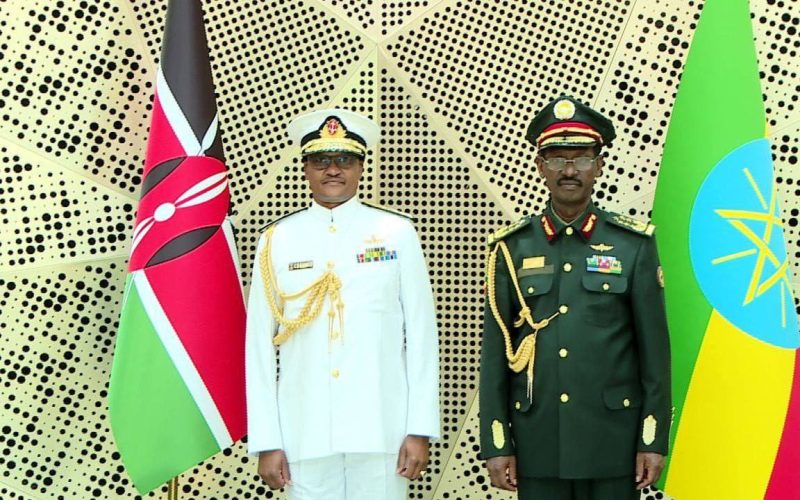
Ethiopia and Kenya have signed a historic military cooperation agreement, the second such accord between the two countries in 62 years.
Officials from both nations described the deal as a milestone for strengthening peace and stability in the Horn of Africa and beyond.
The agreement was signed in Addis Ababa by the Chief of Staff of the Ethiopian National Defence Forces (ENDF), Field Marshal Berhanu Jula, and the Chief of Staff of the Kenyan Defence Forces (KDF), General Charles Muriu Kahariri.
Both military leaders highlighted that the renewed pact would bring mutual benefits, particularly in enhancing regional security and counterterrorism efforts.
General Kahariri reaffirmed Kenya’s commitment to working closely with Ethiopia in joint operations, noting that coordinated action was crucial for addressing common security threats.
The Ethiopian Defence Forces also emphasized that the agreement builds on long-standing cooperation between the two countries.
The first military agreement between Ethiopia and Kenya was signed in December 1963, the year Kenya gained independence.
Since then, the two nations have deepened their collaboration, especially in fighting terrorism, which included commitments not to harbor armed militants.
One of the groups of concern is the Oromo Liberation Front (OLF), which operates extensively in Ethiopia’s Oromia region and is believed to be active in areas along the Ethiopia-Kenya border.
The current agreement is expected to help contain the activities of the OLF’s armed wing and other destabilizing actors.
In recent years, Ethiopia and Kenya have expanded their cooperation beyond security to include trade, investment, infrastructure, and energy projects, reflecting their growing strategic partnership.
However, the signing of this agreement coincides with rising tensions over the Grand Ethiopian Renaissance Dam (GERD).
Egypt has expressed strong disapproval of Kenyan President William Ruto’s attendance at the dam’s inauguration, arguing that it undermines ongoing negotiations among Nile Basin countries.
Egypt’s ambassador to Kenya, Hatem Youssry Hosni, said on Wednesday, September 24, 2025, that the dam’s construction violates international law and does not respect the agreed legal framework.
“We were very disappointed that Kenya was represented at that event. Kenya was the only country from the Nile Basin present. Djibouti and Somalia are not part of the Nile Basin,” he remarked.
While Egypt reiterated that it recognizes the right of all Nile Basin countries to use the river for electricity generation, it expressed deep concern over Kenya’s show of support for Ethiopia.
Meanwhile, diplomatic activity between Ethiopia and Egypt has also intensified.
On September 18, 2025, Egypt’s newly appointed ambassador to Ethiopia, Obaida A. El Dandarawy, arrived in Addis Ababa.
He presented copies of his credentials to Aziza Geleta, Chief of Protocol at Ethiopia’s Ministry of Foreign Affairs.
According to Ethiopia’s Ministry of Foreign Affairs, the discussions with Ambassador El Dandarawy touched on both bilateral relations and broader multilateral issues, signaling an effort to keep diplomatic engagement open despite sharp differences over the Nile.
