
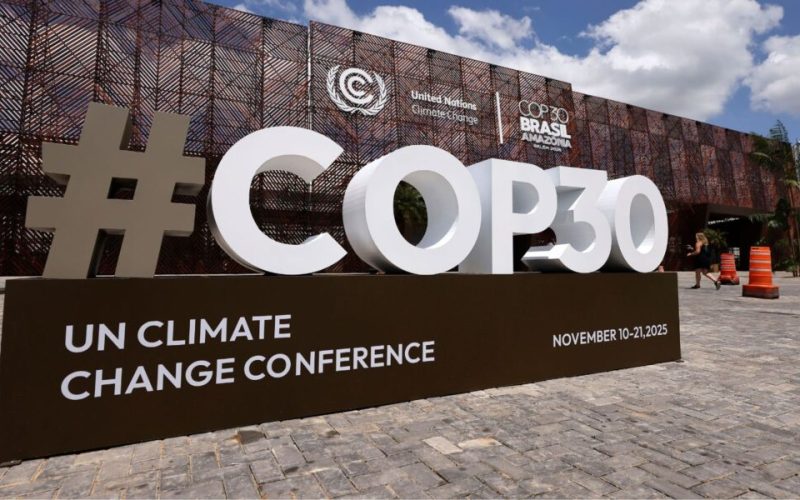
African Civil Society Unites to Demand Climate Justice Ahead of COP30
As the world prepares for the 30th United Nations Climate Change Conference (COP30) in Belém, Brazil, African civil society has delivered a powerful and unified message: climate justice, equity, and accountability are non-negotiable.
In a landmark position paper representing more than 10,000 voices from across the continent, African non-state actors including youth, women, Indigenous Peoples, faith groups, trade unions, and community organizations have outlined their demands under the banner “Repositioning Africa’s Climate Agenda in a Polycrisis Era.”
The statement, coordinated by the Pan African Climate Justice Alliance (PACJA), calls on world leaders to honor long-standing commitments, triple adaptation finance by 2030, and deliver tangible results through the Baku–Belém Roadmap.
“Africa goes to COP30 united and determined to drive a new era of climate justice, shared prosperity, and equitable transition,” the coalition declared. “This is the People’s COP and it must deliver for the people.”
The document stresses that Africa’s climate priorities revolve around adaptation, finance, loss and damage, and just transitions all underpinned by the principle of Common but Differentiated Responsibilities and Respective Capabilities (CBDR-RC).
Civil society leaders argue that the Global North must move beyond rhetoric and deliver on promises of $300 billion in annual climate finance by 2030, scaling up to $1.3 trillion by 2035.
The group insists that climate finance is not charity, but a legal and moral obligation arising from historical emissions.
They also denounce the growing trend of debt-based climate finance, noting that over half of the funds flowing to Africa come in the form of loans, worsening fiscal distress.
Instead, they demand predictable, grant-based funding directly accessible to communities on the frontlines of the climate crisis.
The coalition calls adaptation Africa’s “heartbeat” essential for survival, justice, and development resilience.
With the continent warming faster than the global average and more than 110 million Africans affected annually by climate shocks, civil society demands that adaptation finance be tripled by 2030 and integrated into broader social and economic planning.
They are also urging the establishment of a post-2025 adaptation finance target of at least $310–$365 billion per year, emphasizing locally led adaptation, gender-responsive solutions, and support for Indigenous and traditional knowledge systems.
Three years after the creation of the Fund for Responding to Loss and Damage, its capitalization remains under $1 billion “a level that cannot respond to a single cyclone in Malawi,” the statement laments.
African CSOs are demanding immediate reform and full operationalization of the fund, including direct access for vulnerable communities and rejection of voluntary contributions from developed nations.
They also propose Universal Basic Income as a form of climate reparation for those most affected by climate disasters.
The position paper highlights Africa’s right to a development-driven, people-centered just transition that does not replicate colonial models of extraction and dependency.
Civil society warns that global demand for critical minerals essential for clean energy technologies risks triggering a new wave of exploitative extractivism.
Instead, the coalition calls for a Pan-African Critical Minerals Governance Framework to ensure transparency, value addition, and fair trade. They also demand labour safeguards, gender equality, and inclusion of informal workers, women, youth, and Indigenous Peoples in national transition plans.
Beyond climate negotiations, African civil society is also pressing for deep reform of the international financial system, including debt cancellation, fair taxation of corporations and the wealthy, and democratization of multilateral financial institutions.
They argue that climate finance and debt justice are inseparable, and that the current global economic architecture is “rigged” against developing countries.
“Supporting Africa’s just transition is the single most strategic investment in global climate stability,” the statement asserts.
“Without Africa, there will be no global climate justice.”
The African Non-State Actors coalition brings together diverse movements and institutions from women’s and youth organizations to labour unions, researchers, and faith-based groups united under PACJA’s Climate and Economic Justice Campaign.
With COP30 framed as the “People’s COP,” the coalition’s rallying cry is clear: Africa will no longer accept empty promises, extractive models, or false solutions. It demands real action, real finance, and real justice.
