
Ethiopia Calls for Expanded Seismic Monitoring Network as Volcanic Activity Rises
Ethiopian geophysicists are urging the government to significantly expand the country’s seismic monitoring network following increased volcanic and earthquake activity in the Afar region, including a recent eruption that drew global attention.
Ethiopia currently operates only 10 seismic monitoring stations, but experts say the country needs at least 100 to properly monitor its geologically active terrain.
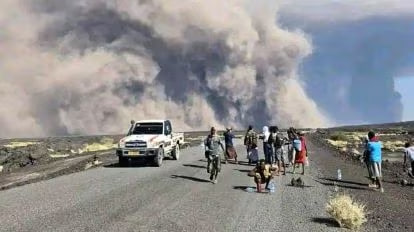
A volcanic explosion occurred on Sunday, November 23, 2025, at Hayli Gubbi in the Afar region an event that released large volumes of steam and ash. The plume traveled long distances and reportedly reached as far as India, causing flight disruptions.
According to Professor Atalay Ayele, Director of the Institute of Geophysics, Space Science and Astronomy at Addis Ababa University, the eruption was part of a broader pattern of unusual seismic activity observed across Afar over the past six months.
He noted that small earthquakes recorded since last year in Awash, Fentale, and surrounding areas are part of the Earth’s natural “self-healing” processes.
Explaining the cause of the Hayli Gubbi eruption, he said: “When pressure builds up inside the Earth, the ground expands and forces molten material upward to release that pressure. This can result in eruptions, tremors, or landslides.”
Professor Atalay added that volcanic activity in Ethiopia is not new, noting that similar deep rock flows and eruptions occur in many parts of the world. The Hayli Gubbi explosion, he said, is comparable to the Ertale lava flow except that Ertale is continuously active.
He also rejected international media reports claiming that Hayli Gubbi had remained dormant for 12,000 years. “It is unlikely that the area remained inactive for that long without any signs. More likely, earlier activity was simply not recorded,” he said.
Regarding claims that volcanic gas traveled to India, he explained that such movement is possible when strong winds and energy from the eruption carry the plume across long distances.
Despite the ongoing monitoring efforts, Ethiopia’s current seismic infrastructure is insufficient. “With only 10 stations, we do not have the budget, equipment, manpower or resources needed to monitor the country adequately,” Professor Atalay said. “For a country of Ethiopia’s size, we need at least 100 stations to effectively record and analyze seismic activity.”
He emphasized that continuous monitoring conducted 24 hours a day, seven days a week is essential for early warning and disaster preparedness.
Ethiopia, with a population of more than 130 million, must strengthen its readiness for natural disasters, he warned.
This includes improving health infrastructure, developing rapid-response systems, ensuring earthquake-resistant construction, and protecting national heritage sites from potential seismic damage.
Professor Atalay urged the government to prioritize investment in additional monitoring stations, noting that accurate and timely seismic data is critical for preventing severe human and economic losses.
