
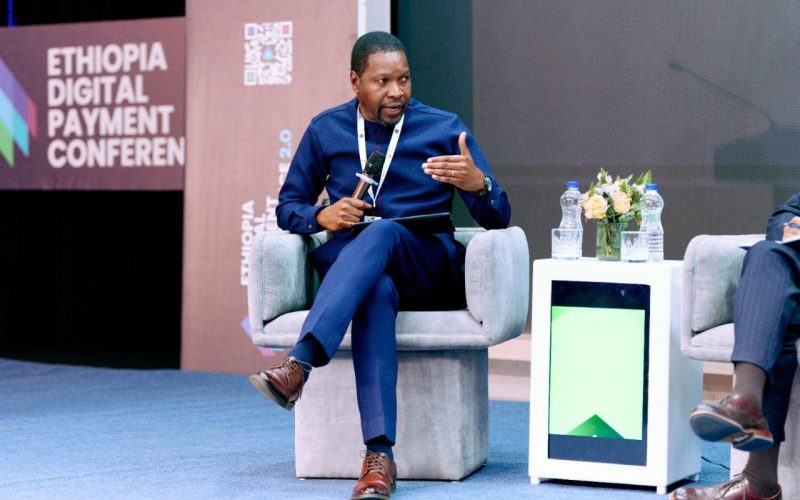
The Ethiopia Digital Payments Conference 2.0 (EDPC 2.0), held in Addis Ababa, marked a decisive shift in the nation’s digital transformation journey from expanding access to driving real usage, rebuilding trust, and positioning Ethiopia within a continental digital economy. Despite rapid growth with an estimated 128 million mobile money accounts only 16% are actively used. EDPC 2.0 confronted this gap head-on with the launch of the National Digital Payments Strategy (NDPS 2026–2030) and Ethiopia’s new EthioPay Instant Payment System (IPS). The two initiatives aim to enforce interoperability, deepen inclusion, strengthen security, and unlock cross-border trade.
It was against this backdrop of ambitious strategic launches that we met with Oswell T. Kahonde, Head of Africa for the Better Than Cash Alliance (BTCA), a United Nations-based partnership of governments, international organizations, and private sector actors. Established in 2012, the Alliance works globally to accelerate the transition from cash to responsible digital payments, advocating for inclusive financial systems that benefit governments, businesses, and people especially women and marginalized communities. Mr. Kahonde shared his insights on Ethiopia’s digital payments journey, the shift from counting accounts to driving usage, and the Alliance’s role in harmonizing regulations to support Africa’s continental trade goals. Oswell shared his side of the story during an interview in Addis Ababa this week with Ethio negari. EXCERPTS:
Ethio negari:- Thank you for taking the time to speak with me. To begin, could you please state your full name and your current role within the Alliance?
Oswell T. Kahonde: It’s a pleasure to be here and to speak with you. My name is Oswell T. Kahonde. I am the Head of Africa for the Better Than Cash Alliance. The Better Than Cash Alliance is a United Nations-based alliance that brings together governments, international organizations, and multinational corporations to accelerate the transition from cash to responsible digital payments.
We work primarily with our members. Ethiopia, for example, is one of our members, having joined the Alliance in July 2016. Since then, we have collaborated with them to support their priorities. We do not formulate programs; we work to support our members’ existing programs. Our work is anchored on the UN Principles for Responsible Digital Payments, and we focus on three main areas:
We advocate for responsible digital approaches to payments, emphasizing that we are not opposed to cash but to forms of digitization that exclude already marginalized communities. Alongside this advocacy, we provide advisory support to our members by helping them develop and implement effective strategies, as demonstrated through our work in Ethiopia. As a global alliance, we operate across Africa, Latin America, and Asia, promoting inclusive and sustainable digital transformation worldwide.
Ethio negari: You highlighted the importance of responsible digital payments. Could you elaborate on what “responsible” means in this context?
Oswell T. Kahonde: Responsible digital payments simply means doing it in a responsible way. We have set up nine guiding principles for our members on how to digitize payments without leaving others behind. Digital must be better than cash that is where our name comes from. If digital is not better, people should stick to cash.
For example, consider social protection payments. If you deposit money on my phone, but the area where I live lacks agents to cash out that money, it is irresponsible. I would have to spend money to access my funds, and I would have been better off with cash.
Responsibility means ensuring fairness and transparency in pricing, guaranteeing access to funds for everyone regardless of location for example, by making biometric ATMs truly accessible while promoting interoperability and a cohesive ecosystem in which all facilitators are accountable. It also requires prioritizing women, as generic market solutions often overlook their needs; true financial inclusion is only possible when systems are designed with women at the center.
Ethio negari: What are the key opportunities and major issues shaping the digital payments landscape today, particularly in Ethiopia?
Oswell T. Kahonde: I prefer to call them opportunities, because we now have the data and systems to address the challenges.
Africa has been moving at a very fast pace. Digital transformation follows stages: first, laying the foundational rails (policy, regulation, infrastructure), and then having the private sector invest on those rails. The advent of mobile money has fundamentally changed financial inclusion. Ethiopia, for example, had less than 5 million accounts five years ago. Now, we are talking about over 100 million accounts, largely driven by mobile money. Telebirr alone has more than 50 million accounts.
However, the big issue we are tackling now is the transition from adoption to usage. We are saying: let’s stop counting accounts and start looking at usage. This conference highlighted that explosive growth in accounts (~128 million) masks a low active usage rate of only 16%.
Low usage persists due to several critical gaps: a trust deficit driven by rising fraud, security threats, and low digital literacy especially among women, with a 66% literacy gap highlighting the need for stronger security frameworks and nationwide financial education. Inclusion challenges further compound the problem, with a 10-percentage-point gender gap, a 24-percentage-point rural–urban usage gap, and millions of farmers and MSMEs excluded, while the absence of centralized data exchange prevents financial institutions from using transaction histories for credit decisions.
Additionally, low merchant acceptance limits the daily utility of digital payments and keeps users dependent on cash, making it essential for the new strategy to set ambitious targets to expand merchant participation. To drive digital payments at scale, you must tailor the service to benefit the user. Once the user sees the benefit, adoption and usage become easy. This data-driven approach is guiding our work across agriculture, health, cross-border trade, and other sectors.
Ethio negari: Could you outline the broader continental vision for digital payments and explain how the Better Than Cash Alliance is supporting efforts to reduce fragmentation, especially in light of Ethiopia’s recent launch of EthioPay IPS?
Oswell T. Kahonde: The core vision for Africa is economic growth, which feeds into the AfCFTA and the promotion of intra-Africa trade. For this trade to happen, payments must be seamless and cost-effective. The Secretary-General spoke yesterday about the issue of third currencies. If I want to buy a product from Ethiopia and I am in Nigeria, I should be able to pay in Naira, not seek dollars to pay an Ethiopian who uses the Ethiopian Birr.
The Alliance sits as an adviser on digital finance to the AfCFTA Secretariat. With the digital trade protocols now ratified by more than 50 countries, the next step is implementation and this is where the EthioPay IPS is a major win. The problem of fragmentation, slow and expensive transfers, and reliance on correspondent banks must be solved domestically before we can scale.
Ethiopia’s launch of the EthioPay Instant Payment System (IPS) is the solution to their domestic fragmentation problem. It provides the secure, real-time national backbone for mandatory interoperability for all financial institutions. This is a crucial step for the pillar on Building Robust & Interoperable Infrastructure (BRIDGE).
This domestic success then directly supports continental goals, particularly the plan to enable low-value outbound cross-border transfers via digital channels and to align EthioPay with the Pan-African Payment and Settlement System (PAPSS).
Ultimately, achieving the AfCFTA vision requires two major country-level actions: first, strengthening domestic interoperability by resolving internal system challenges, as Ethiopia is currently doing through EthioPay IPS; and second, advancing cross-border harmonization so that payment systems can work seamlessly across nations, which will require central banks to align regulations and remove barriers that hinder cross-border trade.
Ethio negari: Turning to the conference itself, how would you assess its outcomes, and what would you identify as the key achievements that define its success?
Oswell T. Kahonde: This conference is part of our work with the Government of Ethiopia, through the National Bank of Ethiopia. The driving purpose of this second conference was to launch the National Digital Payment Strategy 2.0 (NDPS 2026–2030), which we have spent the last year developing. It was meant to let the world know the strategy is out and to rally the local ecosystem around the central bank’s vision.
The conference exceeded expectations by moving beyond discussions and unveiling concrete solutions. Its success was defined by three major outcomes: the launch of the NDPS 2026–2030, an ambitious five-year roadmap built on six pillars that aims to raise the value of digital payments from about 82% of GDP to 750% by 2030 while increasing both active usage and merchant participation to 60%; the introduction of the EthioPay Instant Payment System (IPS), which serves as the legal and technical backbone for instant settlement and lays the foundation for realizing the continent’s digital vision; and a strong focus on resilience and inclusion, including discussions on frontier issues such as AI’s role in combating fraud already being utilized by Ethio Switch and a dedicated pillar on “Reaching All Ethiopians” that mandates tailored products to meaningfully close the gender and rural–urban usage gaps.
The Governor (Eyob Tekalign – PhD) laid out clear calls to action: collaboration, prioritizing interoperability, prioritizing women, and prioritizing rural reach. It is a vital platform to learn from each other and celebrate successes.
Ethio negari: Thank you for sharing these insights. Before we close, do you have any final thoughts or messages you would like to leave with our readers?
Oswell T. Kahonde: Thank you for having me. My final thought is a call to action: we must solve African problems as Africans. Our role at the Better Than Cash Alliance is to facilitate that, and we call upon our colleagues and development partners to collaborate.
Let’s invest more in driving usage and move away from just counting accounts. Let’s drive interoperability across borders. To the central bankers and regulators, let’s put our heads together and harmonize regulations for the betterment of our continent. We will achieve far more if we do this together. Thank you.
