
By Demeke Kebede
The Silent Crisis of Ethiopia’s Creative and Cultural Economy: The High Price of Ignoring Copyright
In the heart of Addis Ababa, music producers craft beats poised for global charts, while filmmakers lens narratives that capture the very soul of the Ethiopian experience.
Across the city, television studios and digital platforms are pioneering a new media landscape, blending local storytelling with international production standards.
In Shiromeda, artisans weave vibrant Gamo textiles a living thread of centuries-old heritage into modern markets. Nationwide, circus performers, acrobats, and dance troupes rehearse routines that fuse ancient tradition with bold innovation. From software developers and designers to writers and digital creators, Ethiopia’s creative talent is arguably its most renewable and untapped resource.
Yet, a haunting question looms over this brilliance: Will these creators ever receive the compensation they deserve, or will their intellectual labor vanish into the hands of others without credit or payment?
This is the silent crisis of Ethiopia’s creative and cultural economy. It is a sector encompassing music, film, publishing, fashion, software, gaming, circus, dance, crafts, textiles, and media content production a sector currently standing at a crossroads between systemic exploitation and sustainable prosperity.
Understanding the “Orange Economy”
The creative and cultural economy often termed the “Orange Economy” represents the intersection of creativity, knowledge, and cultural heritage.
The color orange is traditionally associated with culture and innovation, making it the perfect label for an economy fueled by human ingenuity rather than raw materials.
Unlike the traditional “Green Economy” (agriculture) or “Brown Economy” (extractives), the Orange Economy is inexhaustible; it relies on the transformation of ideas into cultural goods and services whose value is protected by Intellectual Property (IP).
Global and Regional Perspectives
Worldwide, creative industries account for roughly 4.73% of global GDP, outperforming traditional sectors like mining and hospitality. Nations that aggressively protect IP rights reap the rewards: In 2024, the UK’s creative sector contributed £115.9 billion to its economy, while South Korea’s strategic investment in K-pop and gaming generated $14.5 billion in exports in 2023.
Across Africa, the shift from viewing culture as “entertainment” to viewing it as “industry” is yielding transformative results:
By mid-2025, Kenya’s creative sector is projected to contribute 10 percent of the national GDP, growing 60 percent faster than traditional industries, highlighting the sector’s rising economic importance.
In Nigeria, the film industry popularly known as Nollywood generates more than $600 million annually and has become the country’s second-largest employer after agriculture, underscoring the power of creative industries to generate jobs at scale. Meanwhile, Botswana demonstrates that creativity can be a major economic driver even in smaller economies, with copyright-based industries contributing 5.46 percent of GDP.
Similarly, Morocco’s strategic investment in cinema infrastructure has paid off, with international film production revenues reaching 1.5 billion dirhams in 2024, positioning the country as a competitive global filming destination.
Ethiopia’s Cultural Assets as Economic Engines
Ethiopia’s potential extends far beyond modern media. Our traditional crafts like the iconic Gamo woven fabrics preserve identity and generate vital income when protected and marketed correctly.
Performing arts, including circus troupes and contemporary dance, bring cultural experiences to global audiences.
Furthermore, media companies producing original series and documentaries drive urban employment and nurture a sophisticated workforce.
When we protect our IP, we are not just protecting “art” we are protecting a multibillion-birr industry that can reduce reliance on imported media and support community development in both rural and urban areas.
The Piracy Deficit: A Drain on Sovereignty
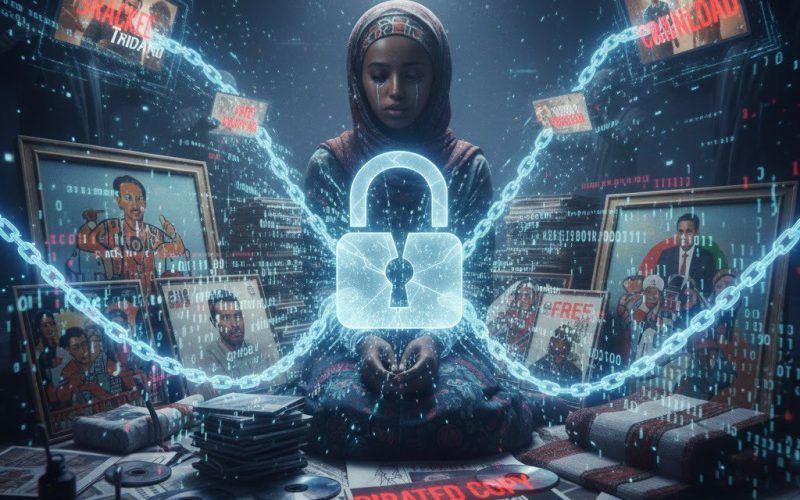
Despite this potential, Ethiopia is suffering from a “Copyright Deficit.” Experts estimate an annual loss of 23.8 billion birr due to piracy and lackluster IP enforcement. This is money being siphoned away from creators, artisans, and public revenues.
To be sure, enforcing copyright in a developing economy is complex. Critics often argue that enforcement could limit access to content for low-income citizens.
However, IP protection is not about restricting access; it is about ensuring the person who planted the crop is the one who harvests the grain. Without it, the “soil” of our creative industry becomes exhausted.
In the absence of a functional royalty and intellectual property ecosystem, creators and performers struggle to earn sustainable livelihoods from their work, while artisans are unable to monetize their designs or protect traditional patterns from misuse.
Media companies face widespread theft of original content, which erodes incentives for future investment and innovation. At the same time, local digital platforms are undermined by illegal copies, stalling the growth of a viable domestic digital economy and weakening the overall creative industry value chain.
Beyond Enforcement: The Need for Legal Alternatives
Copyright infringement and Piracy flourishes where legal access is difficult. Ethiopia must pair enforcement with the development of affordable, local digital platforms.
We need an ecosystem where a citizen can easily and legally stream a local film or buy a song for a fair price. By making legal consumption easier than piracy, we provide a sustainable revenue stream for our creators.
Fortunately, several key initiatives are already making a measurable impact in strengthening Ethiopia’s creative and intellectual property ecosystem. The Ethiopian Intellectual Property Authority (EIPA) is coordinating copyright registration, public awareness campaigns, and anti-piracy efforts in collaboration with law enforcement agencies.
Selam Ethiopia, through its SIPRE Project, together with UNESCO, is playing a critical role in educating creators about intellectual property rights while advocating for the integration of culture into national economic planning. The Ethiopian Media Council (EMC) is also actively promoting responsible content consumption and working to curb the unauthorized distribution of television series and films.
In parallel, Collective Management Organizations (CMOs) are emerging as essential institutions for ensuring the transparent and fair collection and distribution of royalties, while initiatives such as Partners Against Piracy (PAP) supported by private sector actors including MultiChoice are contributing monitoring tools, enforcement support, and international best practices.
To build on this momentum, Ethiopia must take several strategic steps. First, EIPA should be further strengthened with adequate resources and authority to enable rigorous enforcement of laws protecting creative and cultural works.
Second, CMOs must be empowered to ensure transparent and comprehensive royalty collection across all creative sectors, including performing arts and media. Third, the government should expand public–private partnerships, modeling anti-piracy efforts on successful collaborations such as PAP.
Fourth, access to legal content must be broadened by incentivizing affordable local platforms for music, film, and original media. Finally, intellectual property and cultural heritage should be fully integrated into national development policy, firmly linking the growth of the Orange Economy to employment creation and export objectives.
The Choice Before Us
Every pirated song, illegally shared dance performance, or reproduced Gamo textile pattern represents a lost job and a diminished future. Conversely, every royalty paid and every copyright protected strengthens Ethiopia’s economy.
Ethiopia’s creative and cultural economy is renewable, globally relevant, and capable of driving sustainable growth. Protecting it is more than a legal duty it is an economic, cultural, and national imperative.
Respect creativity. Protect originality. Preserve culture. Build Ethiopia’s future.
Editor’s note: – views in the article reflect the views of the writer only!!
