
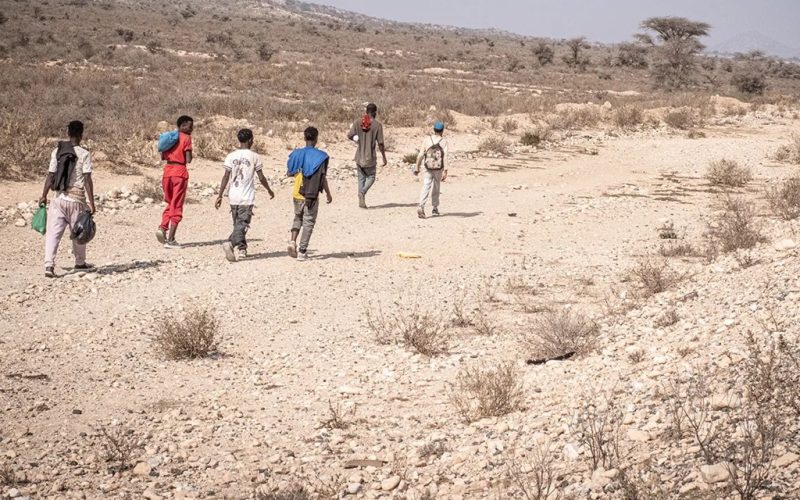
Members of the Amhara Regional Council have raised serious concerns over what they described as an “extremely alarming” exodus of residents from the region, warning that large numbers of young people and productive workers are leaving their communities amid ongoing conflict and instability.
The concerns were raised during a regular meeting of the regional council on December 27, 2025, where the Amhara Regional Education Bureau presented its five-month performance report.
According to the bureau, only 36 percent of secondary school students in the region have returned to school during the past five months, underscoring the deepening crisis facing the education sector.
Council members attributed students’ absence from school to multiple factors, including armed conflict, displacement, persecution, child labor, and growing disillusionment with education.
In some areas, officials said it has become impossible to obtain reliable information about students who have not returned to school, as families themselves are displaced or unreachable.
“The education sector is in serious trouble,” one council member said, noting that authorities in several districts are unable to trace the whereabouts of students or even contact their parents.
“If there is no information about these children, how can we bring them back to school?” the member asked.
Council members also warned that migration has become widespread even in areas where it was previously uncommon.
One member described the trend as “very dangerous,” explaining that teenagers are crossing the Abay lowlands on foot toward Addis Ababa, often in search of work or survival.
“There is no doubt that these young people are migrating because they are desperate,” the member said.
The exodus of the productive workforce is already being felt at the local level.
In Dejen town, a council member said authorities were “shocked” by the number of people seen leaving the area in recent days.
Many of the displaced children, he added, are being forced into menial labor such as carrying loads or herding livestock, despite lacking basic education.
In his report to the council, Tilahun Werkneh, head of the Regional Education Bureau, said the region had planned to enroll 7.4 million students from pre-primary to secondary levels over the past five months.
However, due to insecurity and lack of peace, only 4.3 million students, or 58.2 percent, were able to enroll.
According to the report, pre-primary enrollment stands at 85 percent, primary enrollment at 58 percent, while secondary school enrollment remains critically low at just 36 percent.
The situation is particularly severe in parts of the Gojjam zones, where enrollment has dropped to 18 percent, prompting calls for urgent intervention.
While noting a slight improvement compared to the previous year, the education bureau warned that the continued disruption poses a major threat to the region’s future human capital and competitiveness.
The bureau also reported that many schools across the Amhara region have been completely destroyed by ongoing fighting, forcing students to study in makeshift shelters under extremely difficult conditions.
Amhara Regional President Arega Kebede acknowledged that the education system is in crisis and called for collective efforts to address the challenges.
He noted that low school attendance remains the core problem and emphasized that the education sector had been struggling even before the current conflict.
However, he did not directly address the sharp rise in migration and displacement during the meeting, which was broadcast by regional media.
In her opening remarks, Regional Council Speaker Fantu Tesfaye said residents of the Amhara region are exhausted by years of conflict and urged armed groups to pursue peace and dialogue.
She stressed that the ongoing fighting has created crises across all sectors, adding that the past two and a half years have clearly shown that war does not provide solutions.
The conflict between government forces and armed groups in the region is approaching its third year, with repeated calls from the international community and humanitarian organizations urging all parties to engage in negotiations to prevent further deterioration of the humanitarian and social situation.

This is an excruciatingly sad story. The youth of that country has been used as cannon fodder since the 1970’s with no end in sight. It needs a divine intervention.