
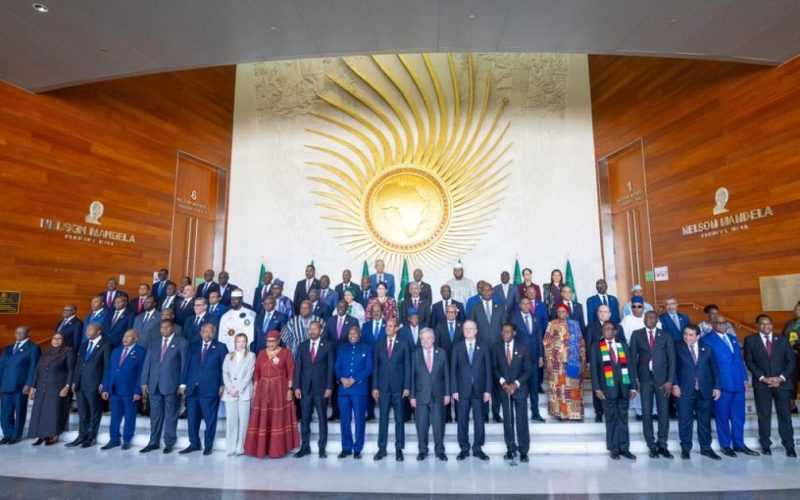
39th AU Summit Concludes in Addis Ababa with Focus on Peace, Water Security and Global Reform
The Thirty-Ninth Ordinary Session of the Assembly of the African Union (AU) concluded at its headquarters in Addis Ababa after two days of high-level deliberations by African Heads of State and Government.
The summit was held under the outgoing chairmanship of João Manuel Gonçalves Lourenço, President of Angola, who served as AU Chairperson for 2025. Leaders formally welcomed Évariste Ndayishimiye, President of Burundi, as the new Chairperson of the African Union for 2026.
The Assembly also launched the AU Theme of the Year for 2026: “Ensuring sustainable water availability and safe sanitation systems to achieve the goals of Agenda 2063,” signaling renewed continental focus on water security and public health.
Leaders expressed deep concern over persistent conflicts, terrorism, violent extremism, unconstitutional changes of government and humanitarian crises across parts of the continent. The Assembly reaffirmed the Union’s zero-tolerance stance on unconstitutional changes of government and reiterated its determination to “silence the guns” in Africa.
The summit underscored the need for predictable, sustainable and flexible financing for AU-led peace support operations. It also adopted a Memorandum of Understanding between the AU, Regional Economic Communities (RECs) and Regional Mechanisms (RMs) to strengthen coordination and operational readiness of the African Standby Force.
The Assembly reviewed progress on institutional reforms and reaffirmed its commitment to building a more efficient, accountable and financially sustainable Union.
Leaders adopted reports from key AU bodies, including the Africa Centres for Disease Control and Prevention, the African Peer Review Mechanism, AUDA-NEPAD and the Committee of Ten (C-10) on UN Security Council Reform.
The Assembly reiterated Africa’s Common Position on reforming the UN Security Council and renewed its demand for equitable African representation in global governance institutions.
The summit also welcomed a briefing on the G20 Leaders’ Summit held in Johannesburg in November 2025, stressing the importance of coordinated African positions on debt restructuring, climate action, food security, digital transformation and sustainable development financing.
Heads of State reaffirmed the centrality of Agenda 2063 as Africa’s long-term development blueprint.
They welcomed progress under the Comprehensive Africa Agriculture Development Programme (CAADP) and called for urgent transformation of African food systems to strengthen resilience against climate shocks.
Leaders also commended advances in implementing the African Continental Free Trade Area (AfCFTA), urging Member States to accelerate implementation to boost intra-African trade, industrialization and value addition.
The Assembly considered a study examining the implications of recognizing colonization as a crime against humanity and certain acts during slavery and colonization as genocide against African peoples. Leaders emphasized the importance of historical justice, truth, remembrance and reparatory justice.
The summit further reiterated the AU’s solidarity with the Palestinian people and called for a just and lasting solution in accordance with international law and relevant United Nations resolutions.
Heads of State adopted the Decisions, Declarations and Resolutions of the session and expressed appreciation to President Lourenço for his leadership during 2025. They pledged full support to President Ndayishimiye as he assumes the AU chairmanship for 2026.
The Assembly also thanked the Government and people of Ethiopia for hosting the summit and providing the facilities that enabled its successful convening.
