
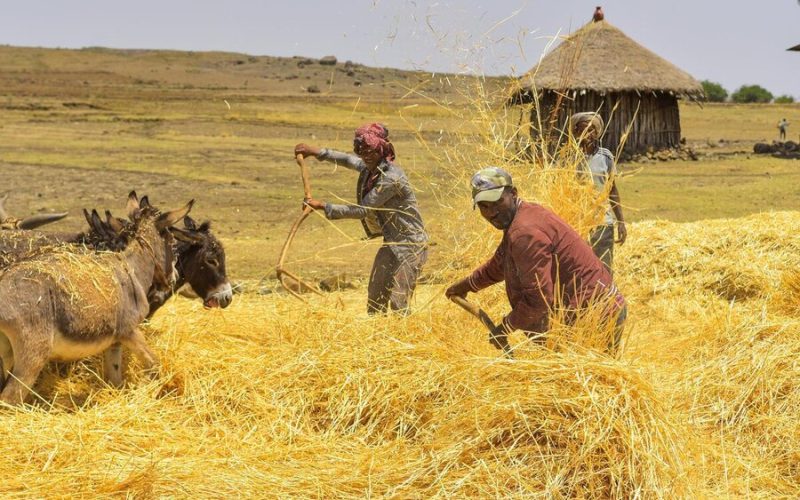
Draft Law Seeks to Allow Smallholder Farmers to Form Agribusiness Companies
The Ethiopian government has introduced a draft proclamation that would allow smallholder farmers, pastoralists, and semi-pastoralists to establish agribusiness companies and operate on commercial principles, replacing the current system in which producers largely work independently.
The proposed Agribusiness Company Proclamation, presented to Parliament by the Standing Committee on Agriculture, aims to strengthen the economic position of small-scale producers by granting them legal business status, improving access to finance, and enabling direct participation in domestic and international markets.
According to the explanatory memorandum accompanying the draft law, the new framework would allow farmers to access bank loans and other financing opportunities, obtain foreign exchange, secure insurance services, negotiate better prices for their products, and directly export value-added agricultural goods.
The government says the legislation is intended to address long-standing challenges facing small producers, including weak bargaining power, limited market access, and dependence on middlemen.
Existing practices often force farmers to sell raw products without value addition, preventing them from earning profits commensurate with their labor and investment.
Under the proposed law, farmers and pastoralists would be encouraged to organize themselves into agribusiness companies capable of jointly producing, processing, and marketing agricultural products.
Officials argue that collective operations would help producers secure better prices and reduce the influence of informal marketing chains.
The draft proclamation defines an agribusiness company as an entity formed by individuals or organizations engaged in agricultural activities.
It also provides a legal pathway for agricultural cooperatives and clustered farming groups to transform into commercial agribusiness companies.
To establish such a company, the draft sets minimum membership requirements. Grain and pulse producers would need at least 300 founding members, while producers engaged in vegetables, fruits, or livestock would require a minimum of 150 members.
However, the government may adjust these thresholds through directives based on local conditions and economic viability.
The proposal further states that an agribusiness company may be registered once at least 25 percent of its declared share capital has been paid.
Regarding ownership and capital requirements, all shares must have equal value, with the price of a single share set at no less than 1,000 birr.
The minimum paid-up capital required to establish an agribusiness company would be 1.5 million birr.
The draft also limits ownership concentration. While members involved in grain production must purchase at least five shares, those engaged in horticulture or livestock production must purchase a minimum of ten shares. No individual member would be permitted to own more than 15 percent of the shares approved for sale by the general assembly.
The proposed companies would be allowed to engage in a wide range of agricultural activities, including the supply of improved seeds, fertilizers, agrochemicals, agricultural machinery, livestock, and other farm inputs. They would also be permitted to establish agricultural processing industries to add value to farm products.
A key feature of the draft law is a package of tax and investment incentives. Agribusiness companies would be exempt from taxes on imported agricultural technologies, machinery, vehicles, spare parts, and construction materials required for their operations.
The companies would also receive priority access to foreign currency for importing essential inputs.
In addition, members would be exempt from income tax on the sale of agricultural products they produce and on dividends distributed by the company.
However, the agribusiness companies themselves would remain subject to corporate taxation in accordance with Ethiopia’s Income Tax Proclamation.
If approved by Parliament, the law is expected to create a new business model for Ethiopia’s agricultural sector, enabling small-scale producers to participate more effectively in commercial agriculture, value-added production, and export markets.
