
Constitutional Reform, Government Structure Among Key Agendas of Ethiopia’s National Dialogue Conference
Constitutional amendment, the structure and form of government, and the organization of federal cities will be among the key issues to be discussed at Ethiopia’s upcoming National Dialogue Conference, scheduled to take place over three weeks on July 15, 2026.
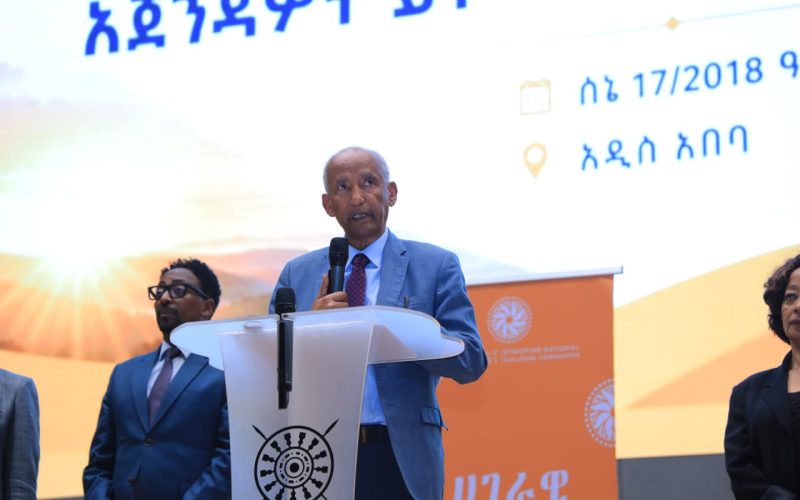
The Ethiopian National Dialogue Commission unveiled the conference agendas on Wednesday, June 24, during an event held at the Adwa Victory Memorial Museum in Addis Ababa.
Speaking at the event, the Commission’s Chief Commissioner, Professor Mesfin Araya, said the agendas were developed through consultations involving more than 200,000 individuals across the country and abroad.
“The agendas are the result of deliberations and views collected from more than 200,000 people,” Mesfin said, adding that the Commission’s own research and studies also served as inputs in identifying the key issues.
The Commission selected eight major agenda areas based on their national significance and their importance to Ethiopia’s future.
The first and highest-priority agenda focuses on nation-building, covering issues related to identity, belonging, historical narratives, diversity management, language policy, and the protection of cultural and historical heritage.
The second agenda, titled “Government Organization and Political System,” includes discussions on the country’s political structure, electoral system, alternative models of governance, and the strengthening of democratic practices.
Key issues under this agenda include constitutional amendments, the form of government administration, the right to self-determination, the status of the federal capital, the definition of nations and nationalities, the terms of office of federal and regional governments, and the relationship between the federal government and regional states.
The third agenda focuses on the administration of the federal cities of Addis Ababa and Dire Dawa.
Issues related to Addis Ababa’s budget, its relationship with the Oromia region, the city’s working language, and representation in Dire Dawa are expected to be discussed.
Religious matters constitute the fourth agenda, while the fifth agenda, which addresses institution-building, the rule of law, and human rights, includes discussions on the neutrality of security institutions.
The sixth agenda covers social, economic, pastoral, and agricultural issues, including land ownership and the national population census.
Under the seventh agenda, which focuses on corruption and good governance, participants will discuss the rights of marginalized groups, dual citizenship, media freedom, and accountability mechanisms.
The eighth and final agenda centers on peacebuilding, including transitional justice, reconciliation efforts, and strengthening human rights institutions.
Over the past four years, the Ethiopian National Dialogue Commission has conducted agenda-setting consultations across all regions of the country and among Ethiopian communities abroad, including in Washington, D.C., London, Toronto, Riyadh, and Dubai.
The National Dialogue Conference is expected to bring together representatives from various sectors of society to deliberate on these issues and contribute recommendations aimed at addressing Ethiopia’s longstanding political, social, and governance challenges.
