
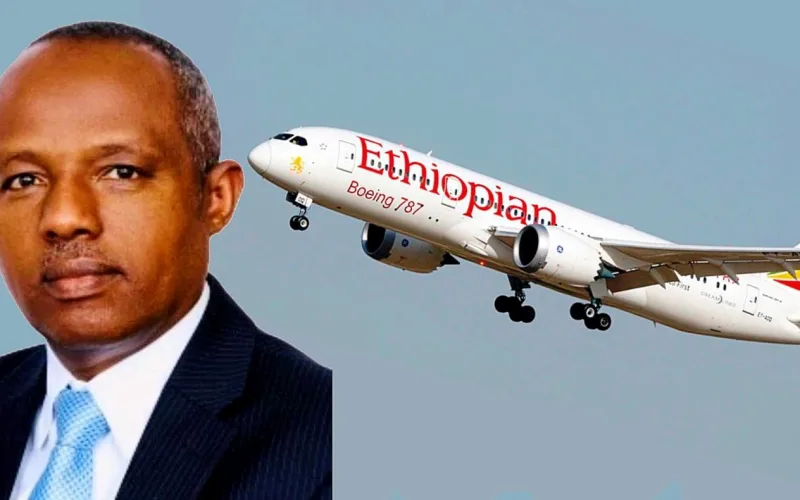
Ethiopian Airlines Group has reported a record US$9.1 billion in revenue for the 2025/26 fiscal year, driven by continued growth in passenger and cargo operations despite rising fuel costs, geopolitical conflicts and travel restrictions.
Speaking at the airline’s annual performance briefing, Ethiopian Airlines Group Chief Executive Officer Mesfin Tasew said the carrier transported 20.7 million passengers during the fiscal year, representing a 10 percent increase compared to the previous year.
Cargo operations also recorded strong growth, with volumes rising by 16 percent year-on-year.
The airline continued expanding its global network by launching services to four new international destinations, bringing its total network to 150 destinations worldwide. Domestically, the airline increased the number of destinations it serves from 22 to 25.
To strengthen its operational capacity, Ethiopian Airlines acquired and leased nine new aircraft during the year. It also purchased eight DA40NG training aircraft for the Ethiopian Aviation University to enhance pilot training.
Despite the strong financial performance, Mesfin said several external factors prevented the airline from fully achieving its growth targets.
He cited the suspension of around 10 flights to destinations in the Gulf region due to regional conflict, a global shortage of wide-body aircraft, and travel restrictions imposed by the United States and some West African countries as major factors that limited the airline’s revenue potential.
Operating costs also rose significantly during the year, with total expenses increasing by 25 percent compared to the previous fiscal year. Mesfin attributed much of the increase to higher global fuel prices driven by geopolitical tensions.
“The fuel shortage in Addis Ababa forced us to refuel our aircraft in neighbouring countries, resulting in substantial additional costs,” he said.
The CEO noted that wars, airspace closures and other geopolitical developments disrupted flight operations, forcing the airline to reroute services and suspend flights on some routes.
He also said passenger traffic between Africa and North America declined following new travel restrictions introduced by the United States.
In Africa, travel demand was affected by restrictions linked to concerns over Ebola outbreaks in the Democratic Republic of the Congo.
Nevertheless, Mesfin said Ethiopian Airlines delivered a strong overall performance, maintaining robust operational growth and achieving record revenue despite the difficult operating environment.
Addressing questions about funds frozen abroad, Mesfin said Ethiopian Airlines has been unable to recover money held in Eritrea because of ongoing political tensions between Ethiopia and Eritrea.
“Currently, relations between Ethiopia and Eritrea are not healthy, so there has been no progress. The matter has effectively stalled,” he said.
He explained that the airline had previously taken the issue to court, but legal proceedings were halted because of political decisions, leaving the company with no option but to wait for improved relations.
According to Mesfin, the funds remain in an Eritrean bank, while the suspension of flights and restrictions on money transfers are tied to the political situation between the two countries.
The CEO added that Ethiopian Airlines also has funds frozen in other countries, including Russia and Mozambique, and that efforts are ongoing to recover those assets.
However, unlike in those countries, the funds held in Eritrea remain inaccessible due to the unresolved political dispute
