
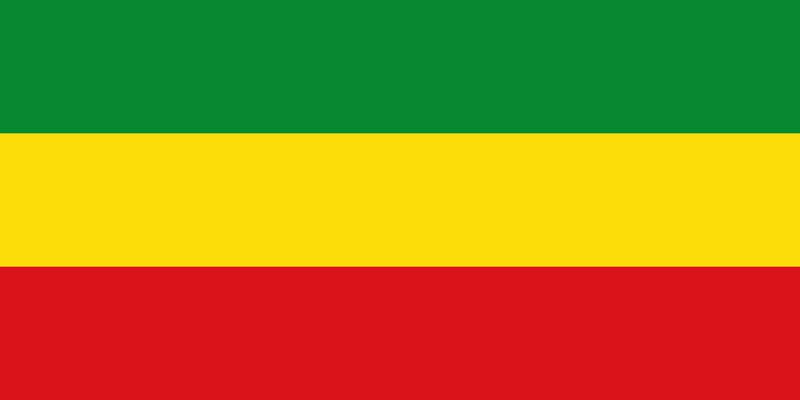
Ethiopian National Dialogue Participants Agree to Retain Flag Colors, Propose Emblem Change
Participants in Ethiopia’s ongoing National Dialogue Conference have agreed that the country’s national flag should retain its traditional green, yellow and red colors, while proposing changes to the emblem at its center.
The issue of the national flag is among the topics being discussed under the national-building agenda of the National Dialogue Conference, which officially opened in Addis Ababa on July 15, 2026.
The conference has brought together more than 4,000 participants, organized into eight thematic groups of about 500 members each to deliberate on eight nationally identified agenda areas.
According to the recommendations presented during the discussions, participants favored retaining the existing tricolor but proposed replacing the current central emblem with a symbol that they believe would be more inclusive of Ethiopia’s history and national identity.
Among the symbols suggested for consideration are the Grand Ethiopian Renaissance Dam, the Battle of Adwa and a dove. Participants also proposed that the final design of the emblem could be determined through a future process involving the Ethiopian public.
Ethiopia’s green, yellow and red colors have a long history and have remained central to the country’s national symbolism for more than a century. Emperor Menelik II officially adopted a green, yellow and red tricolor in the late 19th century, although the arrangement and symbols on the flag have changed under different governments.
The current federal flag, adopted in 1996, consists of horizontal green, yellow and red bands with a blue circular emblem containing a yellow star at the center. The emblem is officially associated with the country’s diversity and unity.
The colors have also acquired broader Pan-African significance, with a number of African countries drawing inspiration from Ethiopia’s historic tricolor after gaining independence.
The proposal to retain the three colors while reconsidering the emblem therefore represents an attempt by dialogue participants to preserve a widely recognized national symbol while addressing differing views over the meaning and inclusiveness of the central emblem.
Participants are also debating whether Ethiopia should have a designated national language.
A group of 120 representatives selected from the eight thematic groups presented recommendations based on discussions held within the broader groups. According to the recommendations presented to participants, one position was that Ethiopia does not currently need to designate a single national language.
Another proposal suggested that, if a national language becomes necessary in the future, the country could select one from among its existing languages depending on circumstances.
The issue of federal working languages has also generated discussion. Consultants initially proposed five languages and later expanded the proposal to 13 languages.
Participants reportedly favored Amharic, Afaan Oromo, Tigrinya, Afar and Somali as federal working languages, while suggesting that additional languages could be considered in the future.
The National Dialogue Conference has also addressed Ethiopia’s national anthem. Participants agreed with the proposal that the current national anthem should remain unchanged.
The discussions form part of a broader effort to identify areas of consensus on some of Ethiopia’s longstanding political, social, historical and national-identity questions.
The National Dialogue Commission says the conference is using a structured process in which participants move from smaller discussion groups to larger groups to identify areas of convergence and refine differing positions.
The recommendations emerging from the conference are intended to contribute to a broader national consensus on issues that have remained subjects of debate in Ethiopia.
