
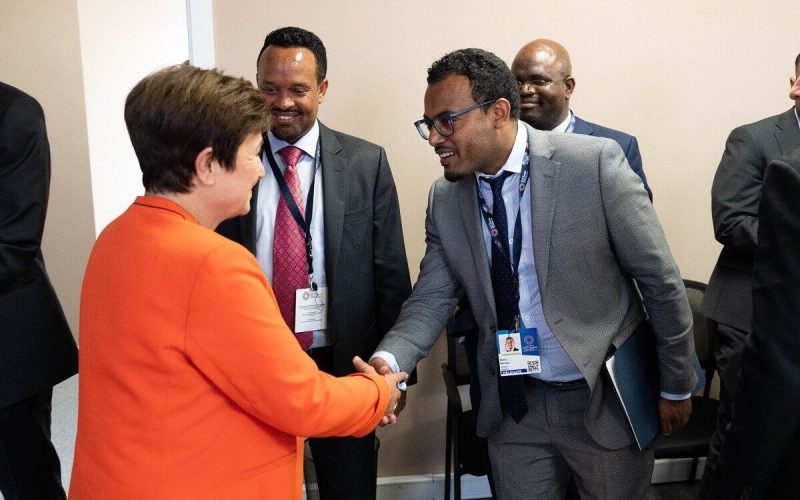
The International Monetary Fund (IMF) has announced an agreement to provide Ethiopia with an additional $251 million in financial assistance.
The loan is part of a broader effort to support the country’s economic reforms and stabilize its economy.
According to the IMF, the loan agreement was reached following discussions between Ethiopian government officials and a team of IMF experts who met in Addis Ababa to review the country’s second economic reform program.
This agreement is subject to the approval of the IMF’s Executive Board, which is expected to make a formal decision in the coming weeks. The IMF also stated that future reviews of Ethiopia’s economic reforms will be conducted every six months.
In its statement, the IMF highlighted significant progress in Ethiopia’s economic landscape.
Specifically, it noted that the country has successfully eliminated its foreign exchange shortage and significantly reduced the gap between the official exchange rate and the parallel market rate. The gap has now narrowed to less than 10 percent.
However, the IMF emphasized the need for Ethiopia to maintain strict monetary and fiscal policies to ensure continued economic stability.
One of the key reforms the country has undertaken is the decision to adopt a free-floating exchange rate, which was implemented in July 2024.
This policy shift, recommended by both the IMF and the World Bank, aims to improve Ethiopia’s foreign trade and address long-standing exchange rate distortions.
Since the implementation of the free-floating exchange rate, the purchasing power of Ethiopia’s national currency, the birr, has significantly depreciated.
As of now, the exchange rate stands at approximately 124 birr to the US dollar, with the black market rate rising as high as 140 birr to the dollar. This depreciation reflects the challenges Ethiopia faces in adjusting its currency and balancing its foreign trade.
In addition to the IMF loan, Ethiopia has secured substantial financial support from the World Bank.
Four months ago, the World Bank’s Board of Directors approved a package worth $16.6 billion in loans and assistance to Ethiopia over the next three years. This package includes a combination of direct financial support, loans, and extended debt relief.
The World Bank’s support is structured as follows: $1 billion in direct financial aid, $500 million in extended loans, and $320 million for international investment cooperation.
Furthermore, the World Bank has committed to providing $1.15 billion through the Multilateral Investment Guarantee Agency (MIGA), as well as $6 billion in budget support over the next three years.
Together with an additional $2.1 billion in international financial cooperation for investment projects, Ethiopia is expected to receive a total of $16.6 billion in assistance, which includes both the World Bank and IMF packages.
This financial inflow is seen as crucial for supporting Ethiopia’s ambitious economic reforms and ensuring the sustainability of its development agenda.
As Ethiopia continues to navigate its economic challenges, the combined support from the IMF, World Bank, and other international partners is expected to play a key role in helping the country stabilize its economy, reduce poverty, and achieve long-term growth.
