
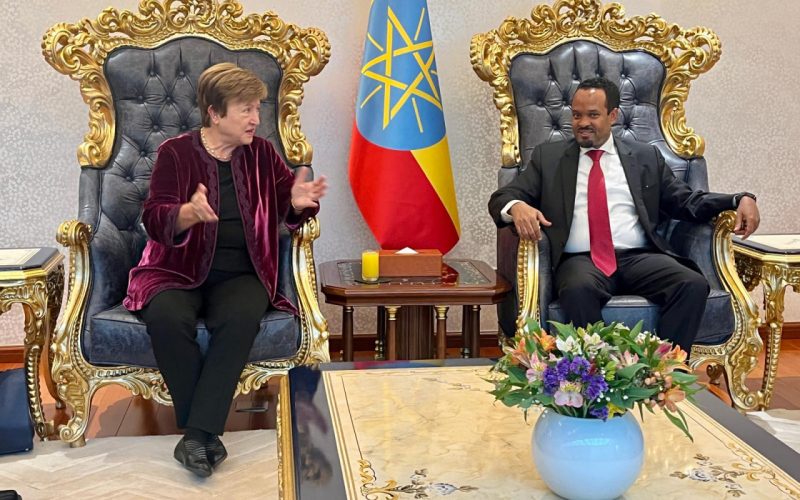
The Managing Director of the International Monetary Fund (IMF), Kristalina Georgieva, arrived in Addis Ababa today for an official two-day visit to Ethiopia.
This marks her first visit to Ethiopia since assuming office in 2019 and is expected to facilitate high-level discussions with Ethiopian leadership and key stakeholders regarding the country’s economic trajectory.
During her stay, Georgieva will meet with Prime Minister Abiy Ahmed and senior government officials to deliberate on Ethiopia’s economic outlook, policy priorities, and the progress of ongoing economic reforms. These discussions will likely focus on critical areas such as macroeconomic stability, debt sustainability, exchange rate policies, and structural adjustments needed to strengthen Ethiopia’s economic resilience.
In addition to her meetings with government officials, the IMF chief will engage with representatives from Ethiopia’s private sector to gain insights into the country’s business environment, investment climate, and economic opportunities. These discussions will allow private sector leaders to share their perspectives on challenges and potential policy measures that could support business growth and economic expansion.
Beyond economic discussions, Georgieva is also scheduled to visit social and development projects to assess the impact of IMF-backed programs on Ethiopia’s economic and social landscape. These site visits underscore the IMF’s commitment to supporting inclusive and sustainable economic development in Ethiopia.
The visit reaffirms the IMF’s long-standing partnership with Ethiopia and highlights its role in fostering economic stability and resilience. In November 2024, the IMF signed an agreement to provide Ethiopia with an additional $251 million in financial assistance as part of its broader effort to support the country’s economic reforms and recovery initiatives. This funding aims to stabilize Ethiopia’s economy and address key macroeconomic challenges.
Currently, Ethiopia and the IMF are engaged in a four-year Extended Credit Facility (ECF) arrangement designed to address macroeconomic imbalances, restore external debt sustainability, and promote private sector-led growth. Recent IMF reviews have acknowledged Ethiopia’s progress in implementing key economic reforms, including improvements in the foreign exchange market and initial steps toward modernizing monetary and fiscal policies.
Despite these advancements, Ethiopia continues to face significant economic challenges, particularly in managing its external debt. According to the Ministry of Finance’s latest quarterly government debt report, Ethiopia’s external debt rose from $28.8 billion in June 2024 to $31 billion by the end of September 2024. This increase is attributed to the introduction of market-based foreign exchange transactions and the government’s receipt of $1.6 billion in loans from the IMF and the World Bank within a three-month period.
Additionally, the report highlights a sharp decline in Ethiopia’s Gross Domestic Product (GDP), which fell from $207 billion in real terms in June 2024 to $100 billion by the end of September 2024. This significant contraction is linked to the introduction of a market-based foreign exchange trading system in July 2024, which had a profound impact on the country’s economic indicators.
As a result, Ethiopia’s total public debt, comprising both domestic and foreign obligations, rose from 32.9% of GDP in June 2024 to 50.3% in September 2024, according to a recent media report. Notably, nearly half of Ethiopia’s total external debt is owed to China, while the remaining portion comes from multilateral institutions such as the World Bank and IMF, as well as various other bilateral lenders.
Given these economic challenges, Georgieva’s visit is expected to play a crucial role in shaping Ethiopia’s economic reform agenda and exploring further IMF support to ensure fiscal sustainability and long-term economic growth. The discussions will reinforce Ethiopia’s commitment to structural reforms and help identify strategies to mitigate the economic strains caused by recent policy shifts.
As Ethiopia continues its efforts to stabilize the economy and attract investment, the IMF’s engagement will be instrumental in determining the country’s financial trajectory and its integration into the global economic landscape.
