
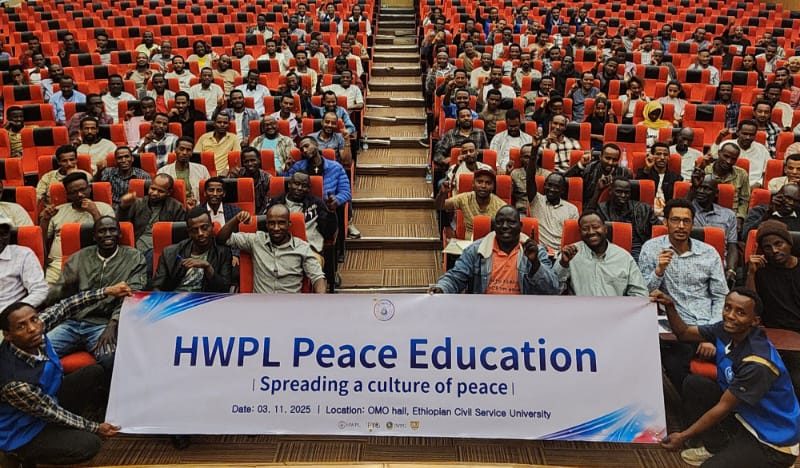
Global Peace Education Meets Local Action: HWPL and ECSU Partner to Cultivate Peace Leaders in Ethiopia
On March 11, 2025, HWPL (Heavenly Culture, World Peace, Restoration of Light), in partnership with the Ethiopian Civil Service University (ECSU), held a peace education seminar in Addis Ababa. Attended by approximately 300 students and two faculty members, the event underscored how global peace initiatives can be translated into local action.
By engaging future public service leaders, the seminar demonstrated how collective participation—through education and civic engagement—can foster social stability and address post-conflict challenges in Ethiopia.
Through this collaboration, HWPL aims to bridge international peace frameworks with local governance, empowering participants to become agents of change in their communities.
HWPL is an UN accredited non-governmental organization committed to promoting global peace through multi-faceted initiatives such as the Legislate Peace Project, the interfaith harmony, and peace education programs.
These initiatives are designed to foster interfaith dialogue, advocate for the institutionalization of peace through legal frameworks, and educate future generations on the values of coexistence and conflict resolution.
HWPL’s peace education emphasizes the role of individuals in sustaining peace, offering both theoretical frameworks and practical examples that can be applied within diverse social contexts.
The partnership between HWPL and ECSU, formalized through a Memorandum of Understanding (MOU), focuses on integrating peace education into the university’s curriculum and public service training.
This agreement includes regular peace seminars, joint research on sustainable peace policies, and the provision of educational resources. ECSU’s commitment to peace education reflects its broader mission to equip public servants with the tools necessary to foster social cohesion and address the root causes of conflict.
The recent seminar was part of this ongoing effort, aligning with national goals to strengthen democratic governance and promote community-led peace building initiatives.
The seminar featured a comprehensive educational program, including a lecture on the Declaration of Peace and Cessation of War (DPCW), drafted by 19 international law experts from 15 countries, and its relevance to national reconciliation efforts.
A screening of “The Great Legacy,” a documentary highlighting successful community-driven peace processes, provided tangible examples of how grassroots participation can lead to sustainable change with an example of Mindanao, Philippines. The event also facilitated open discussions and membership enrollment, with 230 students expressing their commitment by joining HWPL’s peace network.
The peace education session focused on helping participants understand the value of peace and providing practical methods to implement it. During the “Significance of Peace Education” section, the importance of setting clear goals and maintaining continuous action to achieve peace was highlighted, using examples to illustrate how individual efforts can drive social change.
The following lecture, centered on HWPL’s spirit, emphasized the slogan “We can do it,” encouraging participants to overcome differences and challenges through love and solidarity.
In the session on “A Sustainable Peaceful World,” the interconnectedness of humanity was underscored, urging participants to act as agents of peace and contribute to spreading a culture of peace. Finally, the “Peace Practice Examples” section shared real-life cases where collective efforts turned the impossible into reality, providing participants with actionable steps to implement peace in their daily lives.
Participants voiced a strong interest in continuing their involvement with HWPL’s educational initiatives. One student remarked, “This seminar clarified how peace is not an abstract concept but something we can actively work toward. I am eager to be part of this ongoing dialogue.”
Dr. Abraham Hagos, a director of administrative school of the university added, “The collaboration between ECSU and HWPL equips our students with practical knowledge to address social challenges through peaceful and legal mechanisms which is not-so-common material we can access from international society.
Its willingness to adapt its programs to the local situation is unique backed by local teams intimate communication with the faculties.”
Building on the seminar’s success, HWPL and ECSU plan to hold a second round of peace education sessions in conjunction with the upcoming on May 25th event. This future initiative aims to deepen the integration of peace education within ECSU’s academic framework while reflecting participant feedback.
Through sustained collaboration, both organizations seek to cultivate a new generation of public leaders who can translate international peace principles into local policies, advancing Ethiopia’s broader goals of social stability and long-term peace.
