
China Helps Ethiopia Develop Skilled Talent
When a team of teachers from China traveled thousands of miles to Ethiopia, they brought not only professional expertise but also sowed the seeds for educational collaboration between the two countries.
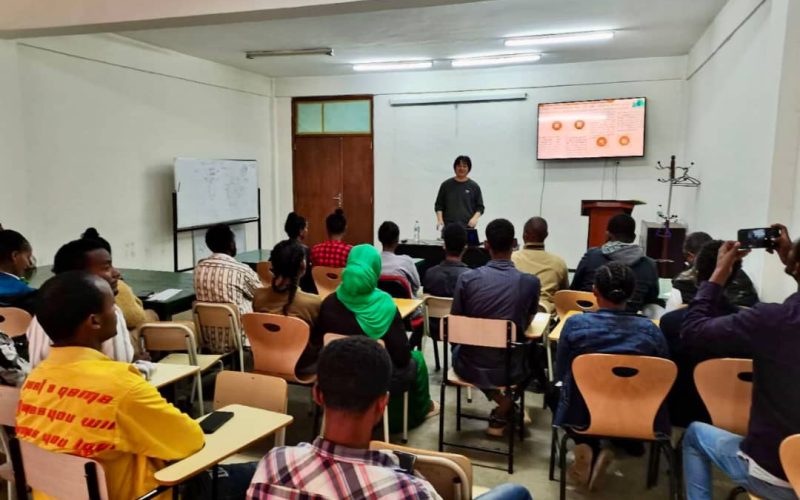
The teachers of the 2025 “Chinese + Vocational Skills” project for China and Ethiopia recently left a profound educational impact at the Federal Technical and Vocational Training Institute (FTVTI) of Ethiopia.
The teachers, hailing from Henan Polytechnic Institute, Puyang Vocational and Technical College, and Nanyang Vocational College of Agriculture, were respectively tasked with teaching mechanical design and manufacturing, new energy vehicle technology, and horticultural technology (with a focus on bamboo resources technology).
After nearly two months of training, three teachers have successfully completed their teaching missions.
The FTVTI held a special graduation ceremony for them, during which first, second, and third-class scholarships were awarded to outstanding students, showcasing the fruitful outcomes of skills training.
The outcomes of this teaching initiative are closely aligned with market demands in Africa.
Ethiopia is currently in the process of industrialization, and the promotion of mechanical design and manufacturing technology will help upgrade the local manufacturing sector.
In the field of new energy vehicles, Africa’s youthful demographic structure and the booming tourism economy are creating substantial demand for new energy mobility solutions.
Currently, the teacher from Nanyang Vocational College of Agriculture remain at his post, continuing to impart practical skills such as bamboo resource utilization.
He is expected to complete teaching mission and return to China on September 21.
The “Chinese + Vocational Skills” model has become a prominent brand in China’s vocational education expansion abroad.
This initiative not only cultivates technical talent but also builds bridges for cultural exchange. By aligning Chinese vocational education standards with local needs, the project ensures that skills training genuinely serves local development requirements.
From classroom instruction to hands-on practice, and from language learning to skills acquisition, this cross-border educational collaboration is yielding fruitful results.
It is not only a vivid example of the internationalization of China’s vocational education but also a living testament to the people-to-people connectivity under the Belt and Road Initiative.
