
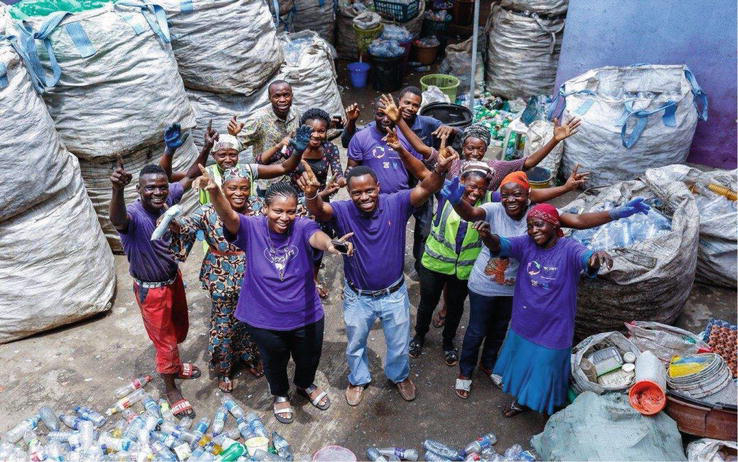
Africa’s Circular Economy Could Add $66 Billion to GDP
A high-level session of the African Circular Economy Alliance (ACEA) with African journalists was held in Addis Ababa. Leaders from the African Development Bank, the Ellen MacArthur Foundation, and other stakeholders participated in the event.
Africa stands at a pivotal moment in its development journey, with the circular economy emerging as a powerful blueprint for sustainable growth, job creation, and environmental resilience.
Yet despite its vast potential, experts say the continent must overcome structural, policy, and investment hurdles to fully harness the benefits of circularity.
Charles Akol, Environment Officer at the United Nations Economic Commission for Africa (UNECA), said that adopting circular economy models could add up to $66 billion to Africa’s GDP and create 11 million new jobs by 2030.
Circular approaches centered on reusing, recycling, and regenerating resources offer Africa an opportunity to shift away from the traditional “take, make, waste” economic model and move toward one that preserves value and supports long-term sustainability.
Circular initiatives across agriculture, textiles, manufacturing, and waste management could unlock over $546 billion in new market opportunities.
With the African Continental Free Trade Area (AfCFTA) enabling cross-border trade in refurbished goods and recycled materials, experts believe that circular trade could drive industrial diversification and economic integration.
In particular, sectors such as automotive recycling, e-waste management, and sustainable packaging are already demonstrating the promise of circularity.
In Kenya, Gjenge Makers transforms plastic waste into durable paving blocks, while in Nigeria, solar-powered cold chains are reducing food waste and boosting agricultural productivity.
Similarly, Rwanda and Kenya’s bans on single-use plastics showcase how regulation can drive both innovation and environmental protection.
The African Circular Economy Alliance (ACEA) and the African Circular Economy Facility (ACEF), supported by the African Development Bank, are spearheading the continent’s transition.
ACEA’s 21 member countries including Ethiopia, Kenya, Nigeria, Ghana, and South Africa—are advancing five “Big Bets”: food systems, packaging, electronics, fashion and textiles, and the built environment.
These sectors were chosen for their transformative potential. Together, they represent a large share of Africa’s GDP, labor force, and export flows.
For instance, circular agriculture alone could sustain 23% of Africa’s GDP and 60% of jobs, while improved recycling systems could recover $3.2 billion worth of strategic materials currently lost to waste.
The Ellen MacArthur Foundation, a leading global advocate for circular economies, highlights Africa’s innovation in this space especially its informal recycling networks, decentralized infrastructure, and youth-led solutions.
Sophie Moggs, a policy expert at the foundation, said that across the continent, 17 countries have developed national circular economy strategies, 36 have banned single-use plastics, and 16 have adopted Extended Producer Responsibility (EPR) schemes policies that require producers to manage the end-of-life impact of their products.
The foundation emphasizes that Africa’s circular transition is not merely an environmental necessity but a strategic economic choice in a world increasingly defined by material competition and resource scarcity.
Circularity enables African nations to reclaim value chains and reduce dependency on extractive industries.
Despite growing momentum, many African governments face policy fragmentation, limited institutional capacity, and linear economic systems that favor short-term profits over long-term sustainability.
The Ellen MacArthur Foundation warns that current policy frameworks are still “built on linear economy assumptions,” creating a competitive disadvantage for circular solutions. Shifting political agendas, lack of policy coherence, and insufficient coordination between climate, industrial, and biodiversity strategies continue to slow progress.
Moreover, expanding circular business models requires investment in infrastructure, skills development, and research and innovation ecosystems.
Experts argue that Africa’s youthful population, rich natural resources, and emerging digital ecosystems make it uniquely positioned to lead a global circular revolution.
The African Union’s Continental Circular Economy Action Plan, supported by ACEA, aims to harmonize standards across the continent, creating predictable markets and attracting international investment in green growth.
As the world shifts toward low-carbon economies, circularity is becoming Africa’s economic and ecological lifeline. With coordinated policies, investment, and innovation, the continent could transform its waste into wealth, redefine industrial competitiveness, and secure a sustainable future for generations to come.
“Circular economy is Africa’s leverage to stay competitive without repeating extractive dependency,” an ACEA official noted. “It’s not just about recycling—it’s about redesigning our economic systems for resilience and shared prosperity.”
By Samuel Abate
