
Ash From Ethiopia’s Afar Volcano Reaches Delhi, Disrupting Flights
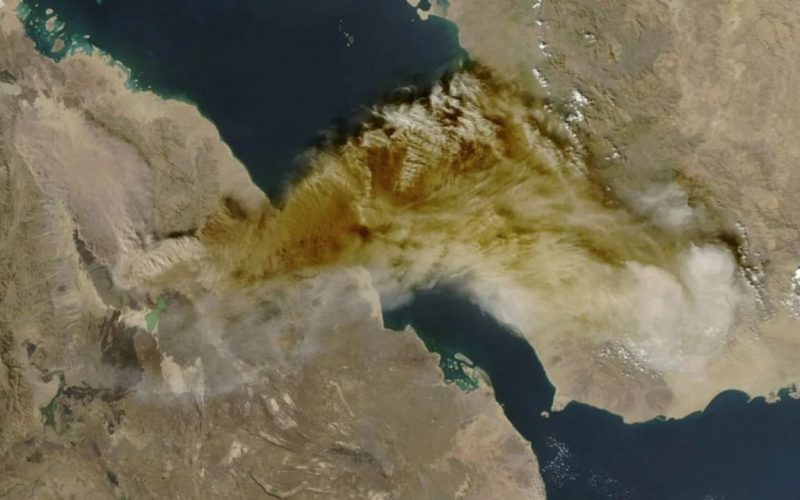
A rare volcanic eruption in Ethiopia’s Afar region has released a large ash plume that has traveled across several countries and reached northern India, affecting air travel in the capital, Delhi.
The ash cloud crossed the Red Sea and passed over Oman and Yemen before drifting toward India, according to meteorological agencies.
The eruption occurred on the morning of Sunday, November 23, 2025, in the Haille Gubbi (Hailey Gubi) area of Afar a volcano that had been dormant for thousands of years.
The long-inactive volcano suddenly expelled vast amounts of ash thousands of meters into the atmosphere, surprising residents and scientists alike.
The ash cloud forced India to take precautionary measures in its aviation sector. Multiple domestic and international flights were canceled, while others were delayed or diverted away from affected airspace.
India’s aviation regulator has advised airlines to avoid routes covered by the ash to prevent engine damage and visibility problems.
Volcanic ash is made up of microscopic, corrosive particles that can severely harm aircraft engines, reduce visibility for pilots, and contaminate airport runways.
As a result, even distant eruptions can pose a serious threat to international air travel.
Although the ash cloud has been detected over northern India, weather experts say it is unlikely to worsen Delhi’s air quality, which was already rated as “very poor” earlier this week.
“The ash layer is between 8.5 km and 15 km above sea level,” explained Dr. Mrutyunjay Mohapatra, Director General of the India Meteorological Department (IMD), in a statement to the BBC.
He noted that the ash could temporarily disrupt satellite signals and flight operations, but it is not expected to affect ground-level weather or pollution.
The IMD believes the cloud reached Indian airspace on Monday evening and may continue drifting toward China in the coming days.
However, Skymet Weather, a private agency, cautioned that the duration of the ash’s presence in the atmosphere cannot yet be predicted.
The IMD estimates that skies over Delhi will likely clear by Tuesday evening.
Experts say that while the current risk remains low, volcanic ash clouds have previously led to major global disruptions.
When Iceland’s Eyjafjallajökull volcano erupted in 2010, thick ash clouds forced the closure of European and UK airspace, causing the worst aviation shutdown since World War II and leaving millions of passengers stranded worldwide.
