
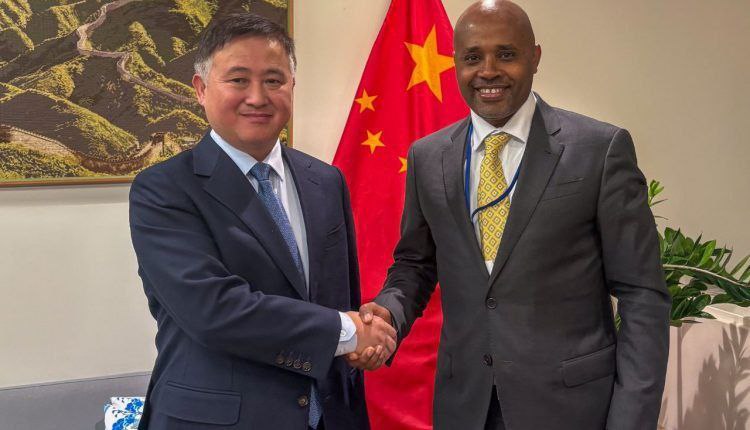
Ethiopia in Talks to Convert $5.38 Billion Chinese Debt into Yuan
Ethiopia has reportedly begun negotiations with China to convert part of its $5.38 billion debt owed to the Chinese government into the Chinese yuan, a move that could help ease pressure on the country’s dwindling foreign exchange reserves.
The initiative mirrors Kenya’s recent debt conversion discussions with Beijing and aligns with China’s broader push to internationalize the yuan as a global reserve and trade currency.
According to Bloomberg, National Bank of Ethiopia (NBE) Governor Eyob Tekalign revealed during his visit to Beijing last month that he had initiated talks with the Export-Import Bank of China and the People’s Bank of China regarding the potential debt swap arrangement.
Eyob reiterated this during an interview on Friday, October 17, 2025, on the sidelines of the International Monetary Fund (IMF) Annual Meetings held in Washington, D.C.
The governor explained that paying off part of Ethiopia’s debt in yuan could reduce the country’s exposure to U.S. dollar fluctuations and stabilize foreign exchange reserves, which have been under significant strain amid persistent balance-of-payments challenges.
Ethiopia currently faces one of the highest external debt burdens in Africa, with outstanding external debt exceeding $30 billion, according to a recent World Bank report.
The report further indicates that the country’s domestic debt has surpassed two trillion birr, translating to approximately $570 in debt per citizen.
China remains one of Ethiopia’s largest bilateral creditors, alongside the World Bank, African Development Bank (AfDB), IMF, and several European countries.
Over the past two decades, Chinese financing has heavily supported Ethiopia’s infrastructure, energy, and transport projects.
Meanwhile, Finance Minister Ahmed Shide, who attended the World Bank and IMF Annual Meetings in Washington last week, held discussions with international partners to secure additional financial assistance.
During a meeting with World Bank Vice President for Eastern and Southern Africa Ndiaye Diop, Ahmed requested increased support for projects focusing on agricultural productivity, energy development, human capital, regional connectivity, and infrastructure expansion, according to a statement released by the Ministry of Finance.
Minister Ahmed expressed appreciation for the World Bank’s continued technical and financial support, emphasizing the government’s commitment to pro-poor economic reforms and urging sustained collaboration to ensure their success.
It is noteworthy that the World Bank approved over $10 billion in financial assistance to Ethiopia last year, disbursed in phases and tied to the country’s ongoing foreign exchange policy reforms aimed at transitioning toward a more flexible exchange rate regime.
Ethiopia’s debt-for-yuan swap could provide a short-term relief to its foreign currency crunch, while also deepening economic and financial ties with China, which remains Ethiopia’s largest trading and development partner.
