Ethiopiadebt

The Price behind the Promise: How Foreign Capital Can Become Ethiopia’s Public Burden

The Price behind the Promise: How Foreign Capital Can Become Ethiopia’s Public Burden

By Ayele Addis Ambelu (media@africanewschannel.org)  This investigative story examines what happens after foreign capital is announced, contracted and disbursed: who negotiates the financing, who controls the contracts, who benefits from the project, what guarantees and foreign-exchange risks are created, how transparently those obligations are reported, and whether project-level economic benefits are large enough to justify the public risks. Its central focus is the gap between the headline value of investment and the ultimate fiscal, governance and accountability cost carried by the Ethiopian state and taxpayers. The reporting uses foreign direct investment, railway financing, public debt, currency depreciation; the Eurobond restructuring…
Read More
Ethiopia Allocates Over Half a Trillion Birr for Debt Servicing

Ethiopia Allocates Over Half a Trillion Birr for Debt Servicing

Ethiopia Allocates Over Half a Trillion Birr for Debt Servicing in 2026/27 Budget The Ethiopian government has allocated more than half a trillion birr for debt servicing in its proposed 2025/26 fiscal year budget, underscoring the growing burden of domestic and external debt on public finances. The federal government has proposed a budget of 2.34 trillion birr for the 2019 Ethiopian fiscal year, which begins in July. Of the total budget, 542.1 billion birr has been earmarked for servicing domestic and foreign debt, representing 43.3 percent of the government's recurrent expenditure. According to the budget explanatory document submitted to Parliament,…
Read More
Ethiopia’s Total Public Debt Reaches $51.8 Billion

Ethiopia’s Total Public Debt Reaches $51.8 Billion

Ethiopia’s Total Public Debt Reaches $51.8 Billion, Finance Minister Tells Parliament Ethiopia’s total public debt has reached $51.8 billion, according to Finance Minister Ahmed Shide, who presented the Ministry of Finance’s nine-month performance report to parliament’s Standing Committee on Planning, Budget and Finance. During the presentation, Ahmed said $33.5 billion of the total debt is external, while the remaining $18.3 billion is domestic debt. The minister explained that of the external debt, $22.1 billion belongs to the federal government, while $11.5 billion is owed by government development agencies. On the domestic side, $17.5 billion is federal government debt and $0.8…
Read More
Ethiopia Seeks to Swap $5.38 Billion Chinese Debt into Yuan

Ethiopia Seeks to Swap $5.38 Billion Chinese Debt into Yuan

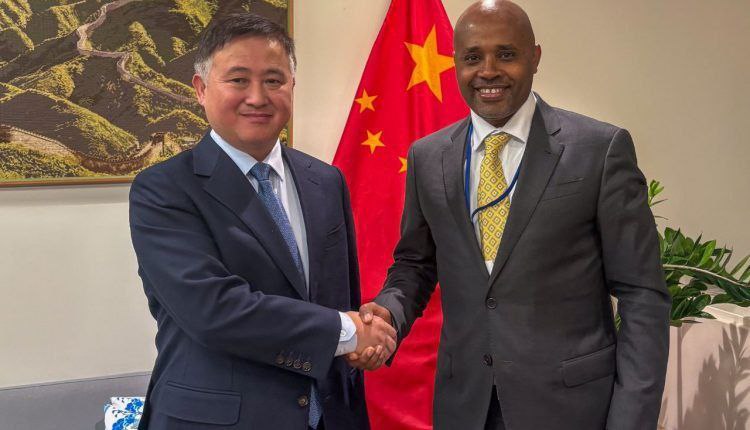
Ethiopia in Talks to Convert $5.38 Billion Chinese Debt into Yuan Ethiopia has reportedly begun negotiations with China to convert part of its $5.38 billion debt owed to the Chinese government into the Chinese yuan, a move that could help ease pressure on the country’s dwindling foreign exchange reserves. The initiative mirrors Kenya’s recent debt conversion discussions with Beijing and aligns with China’s broader push to internationalize the yuan as a global reserve and trade currency. According to Bloomberg, National Bank of Ethiopia (NBE) Governor Eyob Tekalign revealed during his visit to Beijing last month that he had initiated talks…
Read More
Ethiopia’s $1 Billion Bond Talks End Stalled

Ethiopia’s $1 Billion Bond Talks End Stalled

Ethiopia’s $1 Billion Bond Restructuring Talks End Without Agreement Ethiopia’s latest negotiations with bondholders to restructure its $1 billion Eurobond, which matures in 2024, have ended without an agreement, marking a major setback in the country’s efforts to ease its mounting external debt pressure. The Ministry of Finance confirmed that the talks, held between September 23 and October 11, 2025, failed to bridge key differences between the government and bondholder representatives, despite what officials described as “significant progress.” According to Finance Minister Ahmed Shide, the government remains committed to continuing discussions in the coming weeks to reach a mutually acceptable…
Read More
Ethiopia Secures Major IMF Support Amid Debt Burden

Ethiopia Secures Major IMF Support Amid Debt Burden

Ethiopia Secures Major IMF Support Amid Debt and Growth Challenges Ethiopia has received one of the largest International Monetary Fund (IMF) financing packages in Sub-Saharan Africa this year, according to the IMF’s 2025 Annual Report. The Fund approved SDR 2.56 billion (about USD 3.47 billion) under its Extended Credit Facility (ECF) to support Ethiopia’s economic reforms and stabilize its fragile financial situation. The IMF noted that low-income countries like Ethiopia continue to face mounting debt distress, rising inflation, and external shocks from global conflicts and trade disruptions. More than half of low-income countries are now at high risk of debt…
Read More
Ethiopia Begins Talks to Restructure $1B Eurobond

Ethiopia Begins Talks to Restructure $1B Eurobond

Ethiopia Begins Confidential Talks with Private Creditors to Restructure $1 Billion Eurobond Debt The Ethiopian government has entered confidential negotiations with a committee of international bondholders to restructure its $1 billion Eurobond debt, according to Bloomberg. The move marks a critical step in Ethiopia’s ongoing efforts to manage its heavy debt burden and stabilize public finances. The discussions are described as “restricted,” requiring participating lenders to sign nondisclosure agreements (NDAs). This allows the government to share sensitive economic information vital to the restructuring process. Bondholders who sign the NDA are barred from trading Ethiopian bonds during the talks. Ethiopia defaulted…
Read More
Ethiopia’s Domestic Debt Stock Reaches 2.5 Trillion Birr

Ethiopia’s Domestic Debt Stock Reaches 2.5 Trillion Birr

The Ethiopian government’s total domestic debt stock has climbed to 2.5 trillion birr, according to the Ministry of Finance’s latest monthly debt bulletin for August 2025, prepared by the Debt Management Division. The report, cited by The Reporter newspaper, shows that as of June 30, 2025, treasury bonds and loans from state-owned banks made up the largest share of the government’s domestic debt. Long-term treasury bills alone accounted for about 80 percent of the total, with 39 percent classified as long-term obligations. Breaking down the debt sources, the Commercial Bank of Ethiopia (CBE) remains the government’s primary lender, holding 44…
Read More