
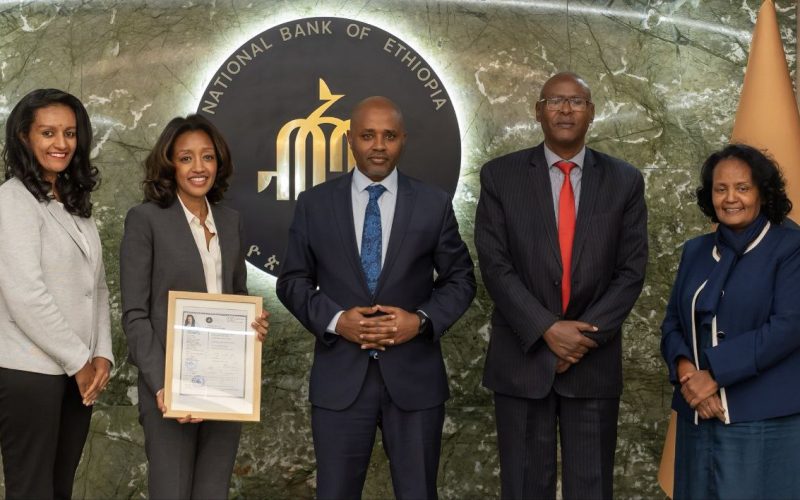
Standard Bank Becomes First Foreign Bank Office Licensed Under Ethiopia’s New Banking Proclamation
The National Bank of Ethiopia (NBE) has officially re-licensed Standard Bank’s Representative Office, making it the first foreign bank office to be authorized under Ethiopia’s newly revised Banking Business Proclamation.
Following the legal reform, the responsibility for licensing and supervising foreign bank representative offices previously overseen by the Ministry of Trade and Regional Integration has now been transferred to the NBE.
As part of the transition, the central bank has begun re-licensing existing foreign representative offices and reviewing new applications.
Standard Bank, which has maintained a representative office in Ethiopia for several years, is the first institution to receive its license under this new regulatory framework.
Representative Offices serve as commercial and liaison hubs for foreign banks. They conduct market research, build business relationships, and facilitate promotional activities but are not authorized to offer banking services or conduct financial transactions within Ethiopia.
In April, the NBE announced that foreign banks intending to operate in Ethiopia must meet a minimum capital requirement of five billion birr (approximately USD 40 million).
The directive introduces strict guidelines governing foreign participation in the country’s banking sector, defining three avenues of entry: foreign bank subsidiaries, foreign bank branches, and representative (branch) offices.
Foreign applicants must undergo rigorous background checks, including tax and criminal investigations, before receiving operational approval.
Additionally, foreign banks must store and process all customer data within Ethiopia, in line with national data protection laws.
The directive also outlines the licensing fees 200,000 birr for the investigation process, 400,000 birr for the initial license, and 400,000 birr for license renewals.
Domestic banks are also expected to raise their standards under the new framework. Requirements include strengthening capital positions, ensuring compliance with data protection regulations, and improving gender diversity in board leadership.
The re-licensing of Standard Bank comes as part of Ethiopia’s broader plan to gradually open its financial sector to foreign competition.
Last year, the government announced that it would issue up to five banking licenses to foreign investors over a five-year period.
Deputy Governor Solomon Desta stated earlier that three to five foreign banks could be permitted during this timeframe in an effort to enhance competition and diversify financial services.
Ethiopia’s banking sector has historically remained closed to foreign institutions, making the current policy shift highly significant.
The National Bank has also signaled the possibility of foreign–local partnerships in future banking ventures.
In parallel, the Ethiopian Capital Market Authority (ECMA) has begun accepting applications for investment banking licenses, further underscoring the government’s commitment to liberalizing the sector.
Banks from countries including Morocco, Kenya, and the United Arab Emirates have already expressed interest in entering the Ethiopian market, according to NBE Governor Eyob Tekalign (Phd).
Beyond banking, Ethiopia continues to attract foreign investment across telecommunications, transport, and aviation sectors that have been steadily opening since Prime Minister Abiy Ahmed took office.
