
The Mohamed bin Zayed Foundation for Humanity has announced a $135 million investment to improve access to essential medicines, medical equipment and healthcare technologies in nine African countries, including Ethiopia.
The commitment, announced on November 26 during the 5th International Conference on Public Health in Africa (CPHIA) in Addis Ababa, is expected to benefit more than 500 health facilities across Ethiopia, Kenya, Liberia, Malawi, Nigeria, Rwanda, Ghana, Sierra Leone and Mozambique.
The investment aims to strengthen primary healthcare services and improve maternal, newborn and child health outcomes by addressing shortages of essential medical supplies and equipment.
The foundation’s funding is also expected to mobilize more than $550 million in additional financing from participating governments and development partners through matching contributions. Each participating government will provide at least an equivalent amount of funding.
Her Excellency Dr. Shamma Khalifa Al Mazrouei, Director General of the Mohamed bin Zayed Foundation for Humanity, said the investment would help ensure that healthcare workers have access to the tools and supplies needed to prevent avoidable deaths.
She emphasized that access to skilled health professionals alone is insufficient without reliable availability of essential medicines and medical equipment.
Across Africa, only 35 percent of essential medicines are available in public health facilities, while fewer than one-third of facilities have the equipment needed to conduct basic diagnostic tests, according to the foundation.
In Ethiopia, the foundation has committed $20 million to the country’s Reproductive, Maternal, Newborn and Child Health (RMNCH) Compact, becoming its first funding partner.
The commitment helped mobilize an additional $151.2 million from development partners, with the Ethiopian government providing matching contributions on a one-to-one basis. This has brought the total financing mobilized under the initiative to $342.4 million.
Over three years, the investment is expected to equip approximately 120 health facilities across Ethiopia with essential medical supplies and technologies.
The planned support includes artificial intelligence-enabled ultrasound equipment to help healthcare professionals identify pregnancy and childbirth complications early, as well as antibiotics to prevent and treat infections such as sepsis.
Ethiopia’s Minister of Health, Dr. Mekdes Daba, said the partnership would strengthen the country’s efforts to improve reproductive, maternal, newborn and child health services.
She said the RMNCH Compact introduces a partnership model based on shared investment and mutual accountability, with the aim of improving access to essential medicines and strengthening healthcare delivery nationwide.
Meanwhile, Rwanda will receive a $15 million commitment to supply essential medical equipment to 170 health facilities, including district and teaching hospitals. The funding is also expected to help mobilize an additional $40 million.
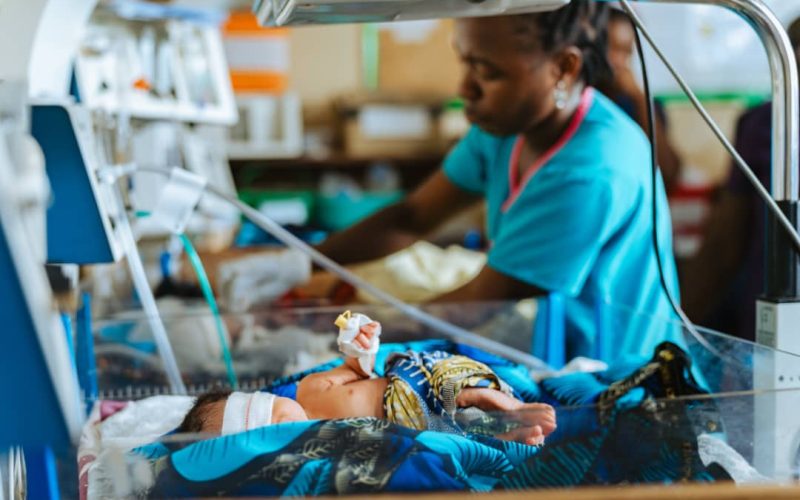
The investment will support safer childbirth and newborn care, including equipment to manage postpartum bleeding, incubators and respiratory support systems for premature and critically ill newborns.
In Liberia, the foundation has pledged $10 million, which will be matched by donor funding to strengthen services at the country’s national referral teaching hospital and associated health facilities.
The support will include technologies for managing complicated deliveries, stabilizing critically ill newborns and children, and conducting faster bedside diagnoses.
The investment will also cover clinical mentorship for doctors, nurses and midwives, alongside efforts to develop national expertise in biomedical engineering to ensure medical equipment can be properly maintained and repaired.
The foundation said the broader initiative reflects growing efforts by African governments to adopt co-financing approaches that combine domestic resources and donor support to strengthen national health systems.
The Mohamed bin Zayed Foundation for Humanity is an international philanthropic organization focused on strengthening health systems, reducing preventable diseases and supporting community development through partnerships with governments and other institutions.
