
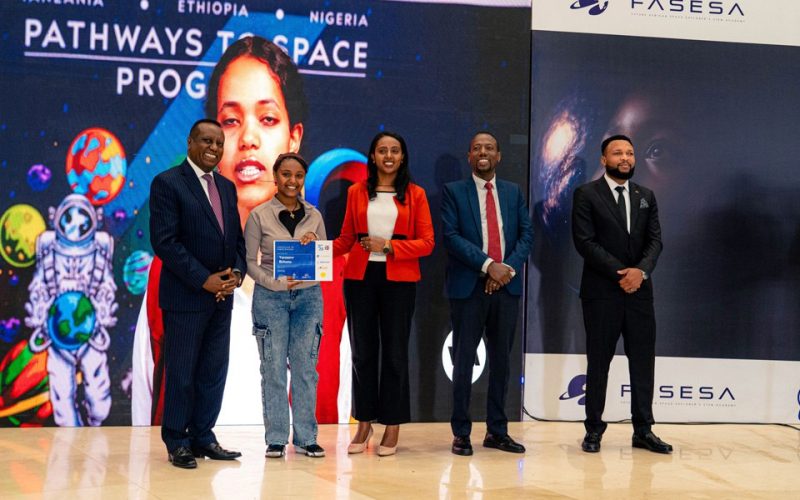
558 Students Graduate from Africa’s Pathways to Space Program
A total of 558 high school students from Ethiopia, Kenya, and Nigeria have graduated from the second edition of the Pathways to Space program, an initiative designed to inspire Africa’s next generation of space scientists and engineers.
The graduation ceremony was held at the Planetarium Dome in the Science Museum in Addis Ababa, organized by the Future African Space Explorers STEM Academy (FASESA) in partnership with Boeing.
The five-month program provided students with immersive training in spacecraft technology, robotics, and extravehicular activity (EVA) simulations, supported by mentorship from international space experts, including former NASA astronaut Dr. Gregory Chamitoff, Columbia Space Shuttle mission physician-astronaut Prof. Jay C. Buckey Jr., and NASA EVA flight controller Dr. Emily Matula.
This year’s cohort included 322 girls, with 109 graduates from Ethiopia, 82 from Kenya, and 367 from Nigeria.
The enrollment nearly doubled from the inaugural 2024 edition, which had 314 participants.
Boeing’s Managing Director for Africa, Henok Teferra Shawl, emphasized the importance of nurturing Africa’s youth for the aerospace sector.
“African youth represent one of the greatest reserves of untapped aerospace talent anywhere in the world. Pathways to Space connects their ambitions with future opportunities, laying the foundation for Africa to increase its contribution to the global space industry,” he said.
Sean Jacobs, founder and executive director of FASESA, highlighted the broader impact of the initiative.
“Through Boeing’s sponsorship and partnerships, we have been able to bring space directly into the classroom.
Pathways to Space is more than inspiration—it is a movement that is shaping the lives of future African space leaders, their communities, and their nations,” he noted.
For many students, the program was transformative. Olyad Dejene, a Grade 10 student from ODA Special Boarding School in Ethiopia, said the experience reinforced his dream of becoming an astrophysicist.
“Working with my team on our capstone documentary wasn’t easy, but it taught us resilience.
The biggest lesson I’ll carry forward is to never give up,” he said.
The program was delivered in collaboration with the Ethiopia Space Science and Geospatial Institute, the Kenya Space Agency, and the Nigeria Space Research and Development Agency.
Over its first two years, Pathways to Space has now reached more than 870 students across Africa, with over half being girls.
Organizers plan to expand the initiative to more African countries and develop advanced training tracks to help graduates pursue higher education and careers in aerospace.
